
Views: 0 Author: Site Editor Publish Time: 2026-09-21 Origin: Site


In high-precision metal stamping, the structural rigidity of an H-frame (straight-sided) press relies entirely on its drive mechanism. Upgrading from a C-frame to an H-frame solves basic deflection issues, but the internal point configuration dictates ultimate performance on the shop floor. Specifying the wrong point configuration leads to severe operational failures. You will experience slide tipping under off-center loads, premature die wear, and unacceptable part tolerances. To maximize tooling lifespan and production uptime, engineers must evaluate the specific mechanical realities of a single-point vs double-point press. This guide breaks down the technical criteria for matching press architecture to specific bed sizes, tonnage requirements, drive systems, and tooling applications. We will look at how force distribution impacts progressive dies and why matching the machine to the metal is non-negotiable.
Load Distribution: Single-point presses excel at high-force, centrally located operations, while double-point presses are mandatory for managing off-center loading in progressive die setups.
Bed Size Constraints: Double-point configurations are required for larger bed dimensions (typically over 48 inches left-to-right) to maintain slide parallelism.
Tonnage Ceilings: Double-Point H Frame Presses generally offer higher maximum tonnage capacities compared to single-point models, making them essential for heavy-duty, multi-station stamping.
Tooling Compatibility: Progressive and transfer dies generally necessitate double-point architectures to prevent slide tipping and protect expensive tooling.
Cost vs. Capability: While Double-Point H Frame Presses require higher initial capital and more complex maintenance, they drastically reduce long-term tooling replacement costs in multi-station applications.
Table of Contents
Establishing the baseline success criteria for straight-sided presses requires a strict focus on minimizing deflection. You must maintain slide-to-bed parallelism under heavy load to produce accurate parts. The H-frame provides superior overall rigidity compared to open-back designs. The internal drive mechanics dictate exactly how that rigidity translates to the tooling. The number of connections driving the slide fundamentally alters force distribution. When you walk a stamping floor, the difference between a machine tearing up dies and one running smoothly often comes down to this internal architecture.
A single-point press uses one connection rod located at the center of the slide to transfer force. This design provides strong and accurate force for centralized operations such as blanking, coining, and deep drawing. However, because the load is concentrated in one area, the slide has less support at the edges. When uneven loads occur, the slide may tilt, increasing guide wear and affecting tooling accuracy. Therefore, single-point presses are best suited for applications where the load remains balanced and centered.
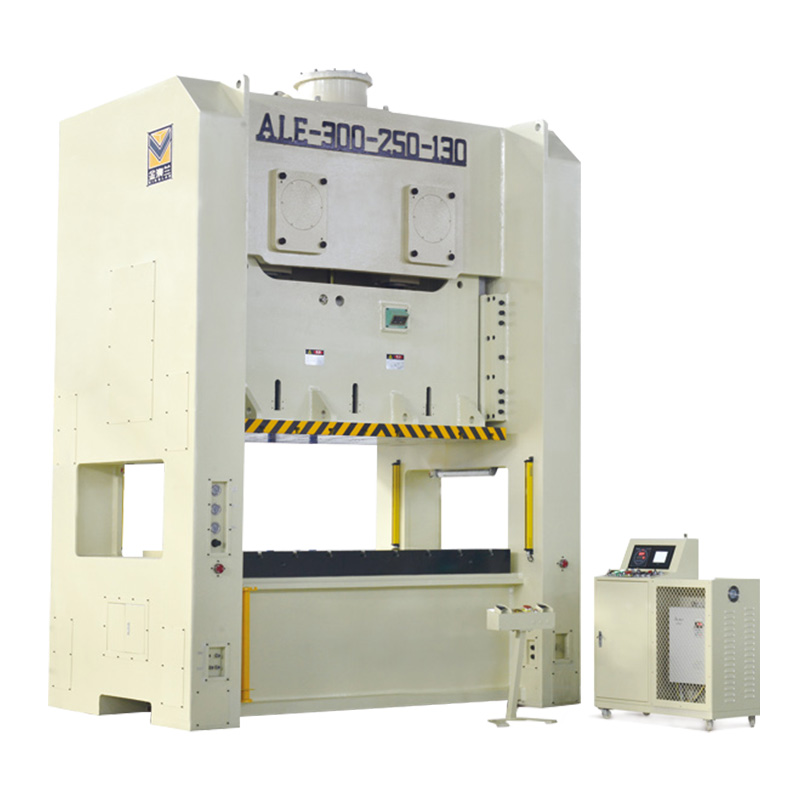
A double-point press utilizes two distinct connections to distribute force across the slide. Instead of a single central pitman, two connection rods attach to the left and right sides of the slide assembly. The drive system frequently employs a longitudinal-shaft drive or dual eccentric gears. These mechanisms synchronize the two connections perfectly, ensuring timed, single-acting strokes across a significantly wider area. The crown of the press houses a much larger gear train to ensure both pitmans move in absolute unison.
This dual-connection design counteracts tipping moments. It applies equalized downward pressure on both the left and right sides of the slide simultaneously. When a load shifts off-center, the secondary connection provides the necessary resistance to keep the slide parallel to the bed. Facilities rely heavily on Double-Point H Frame Presses for multi-station operations, asymmetrical part stamping, and wide-bed applications where force requirements spread across a large physical footprint.
By driving the slide from two points, the machine effectively bridges the gap over the tooling. Think of it like carrying a heavy piece of plywood. If you hold it in the center with one hand, it wobbles. If you hold it with two hands spread apart, it stays flat and stable. This mechanical reality makes double-point architectures the backbone of modern progressive stamping lines. The longitudinal shaft prevents torsional twist, ensuring the left and right sides of the slide hit bottom dead center at the exact same millisecond.
Comparing these two configurations requires analyzing critical engineering and production metrics. You must evaluate how each press handles physical stress, dimensional constraints, and raw force application. We use a specific set of criteria when auditing a stamping line to determine if the press matches the tooling.
Calculate the maximum off-center load generated by the specific die.
Measure the required left-to-right bed dimension to fully support the die shoe.
Determine the total tonnage required and how that tonnage distributes across the stations.
Assess the reverse tonnage characteristics of the material being stamped.
Evaluate the physical space available for automation and scrap shedding.
Off-center loads can affect press accuracy and tooling life. In single-point presses, uneven loading creates a tilting force on the slide, increasing guide wear and causing possible tooling damage. Double-point presses reduce this problem by distributing force through two connection points, improving slide stability and maintaining better alignment during multi-station stamping. This helps protect dies, reduce wear, and improve part consistency.
Press selection depends not only on tonnage but also on bed size requirements. Single-point presses have limited width because the center drive cannot fully support wider slides, which may cause deflection and reduce accuracy. Double-point presses distribute force through two connections, allowing larger bed sizes while maintaining slide alignment. They are better suited for wide tooling, long progressive dies, and large-scale stamping applications.

Total tonnage alone does not determine press capability. Single-point presses work well for centralized loads but face limitations at higher tonnage because the single drive point must handle all forces. Double-point presses distribute the load across two connection points, improving stability and supporting larger tooling areas. For example, a 400-ton double-point press can spread force across a wide progressive die, maintaining better alignment and accuracy compared with a single-point design.
Specification Metric | Single-Point Architecture | Double-Point Architecture |
|---|---|---|
Force Vector | Centralized, single downward axis | Distributed, dual downward axes |
Bed Width Scalability | Limited (typically under 48 inches) | Extensive (easily exceeds 84 inches) |
Eccentric Load Handling | Poor (high risk of slide tipping) | Excellent (inherent lateral stability) |
Drive Mechanism | Single pitman, front-to-back crankshaft | Dual pitmans, longitudinal-shaft drive |
Primary Application | Heavy blanking, deep drawing, coining | Progressive dies, transfer systems |
Gib Wear Potential | High if subjected to off-center loads | Low due to balanced force distribution |
The press configuration must match the tooling requirements. Using the wrong press type can reduce accuracy, increase die wear, and limit production efficiency.
Single-point presses are suitable for single-stage or compact dies where the load stays near the center of the bed. They are less suitable for long progressive dies because changing load positions can cause slide misalignment and uneven tool wear.
Double-point presses are better suited for progressive stamping. Their dual connection design distributes force across the slide, maintaining better alignment during multi-stage operations such as punching, forming, and blanking.
Press rigidity directly affects tooling performance and part accuracy. If the slide tilts during operation, punches and dies may become misaligned, causing faster wear, broken tooling, and inconsistent parts.
Double-point presses improve slide stability by maintaining better parallelism. This helps:
Extend die life
Reduce punch damage
Improve dimensional accuracy
Lower maintenance frequency
Stable slide movement also helps achieve cleaner cuts and fewer burrs on finished parts.
Modern stamping lines often require feeders, transfer systems, and automatic scrap removal. Single-point presses may have limited space for complex automation due to narrower working areas.
Double-point presses provide wider beds and more installation space for:
Servo feeders
Transfer systems
Sensors
Part handling equipment
The balanced force distribution also improves stability when running automated production, helping protect both tooling and automation equipment.
Calculate the maximum off-center load of your largest progressive die to determine the required lateral stability.
Install reverse tonnage monitors on your current equipment to gather accurate baseline data for your next press specification.
Perform a finite element analysis (FEA) on your expected load distribution to identify potential tipping moments before finalizing the press design.
Consult with a press application engineer to review your specific die blueprints and verify bed size requirements.
A: The main difference lies in the number of connections driving the slide. A single-point press uses one central connection, delivering concentrated force to the middle of the bed. A double-point press uses two connections, distributing the force evenly across the left and right sides to resist tipping under off-center loads.
A: It is highly discouraged. Progressive dies create shifting, off-center loads as the material moves through sequential stations. A single-point press struggles to maintain slide parallelism under these eccentric loads. This instability leads to slide tipping, rapid gib wear, and broken tooling.
A: Double-point presses feature significantly larger cast frames to accommodate wider beds and dual connection mechanisms. This added mechanical complexity, including synchronized eccentric gears and longitudinal-shaft drives, drastically increases the overall machine weight, requiring deeper and more heavily reinforced concrete foundations.
A: Off-center loading creates a lever effect that attempts to tilt the press slide. If the press cannot resist this tipping moment, the slide loses parallelism. This forces the gibs to absorb lateral stress, causes punches to enter the die at an angle, and accelerates tooling wear.
A: As an industry rule of thumb, when the left-to-right bed dimension exceeds 48 inches, a double-point configuration becomes necessary. Beyond this width, a single central connection cannot adequately support the outer edges of the slide, leading to unacceptable deflection and poor part quality.
A: No. Tonnage is a rating of the overall press frame and drive system, not a multiplier of the connection points. A 400-ton double-point press provides 400 total tons of force, distributed across two points. However, double-point designs do scale to much higher maximum tonnages.
A: A longitudinal-shaft drive runs parallel to the press bed and is primarily used in double-point presses. It synchronizes the dual eccentric drive systems, ensuring both connection rods move perfectly in tandem. This synchronization guarantees even downward force and maintains strict slide parallelism.