
Views: 0 Author: Site Editor Publish Time: 2026-09-21 Origin: Site


When production scales past the 200-ton threshold, standard stamping machinery hits severe physical limitations. Angular deflection and premature die wear compound rapidly. This destroys part accuracy and inflates maintenance budgets. The engineering challenge centers on maintaining tight part tolerances. You also have to protect expensive progressive dies during continuous-stroke applications where off-center loading is inevitable. Relying on open-frame equipment for heavy-gauge material leads to tooling failures and unacceptable scrap rates.
To solve these structural failures, the H frame power press becomes an absolute necessity for high-capacity manufacturing. Evaluating this equipment shifts the focus from simple tonnage requirements to a comprehensive analysis of frame rigidity and kinematic profiles. Upgrading to a closed-frame architecture fundamentally changes how a stamping facility handles extreme compressive forces and complex multi-station forming operations.
Structural Rigidity Dictates Die Life: The closed-loop, four-pillar design of an H frame eliminates the "yaw" and angular deflection inherent in C-frame presses, directly extending the lifespan of complex progressive dies.
Superior Handling of Off-Center Loads: Symmetrical frame construction and advanced slide guiding systems (e.g., 8-point gibs) maintain parallelism even under severe off-center loading during multi-station stamping.
Foundation and Facility Prerequisites: High-tonnage H frame power presses require significant infrastructure investments, including specialized concrete pit foundations, vibration isolation, and adequate overhead crane clearance.
Long-Term Value vs. Upfront CapEx: While the initial capital expenditure is substantially higher than open-back alternatives, the ROI is realized through reduced scrap rates, fewer die rebuilds, and higher sustained strokes-per-minute (SPM) in heavy-gauge applications.
Table of Contents
High-tonnage stamping introduces extreme mechanical stress to both the machine and the tooling. Success in high-capacity stamping requires a structural foundation capable of absorbing these forces without compromising the dimensional accuracy of the finished part. When you push a press to its limits, you expose every weakness in its casting and assembly.
We see three primary mechanical failure points in heavy stamping environments. First, frame gaping alters the punch entry angle. Second, excessive lateral slide movement causes the punch to shave the die matrix. Third, severe snap-through shock fractures internal press components. You have to engineer these risks out of the process before the first coil is fed.

OBI and C-frame presses provide excellent die access but have lower rigidity under heavy loads. When operating near maximum capacity, the open frame can deform slightly, causing punch and die misalignment, faster tool wear, and reduced part accuracy.
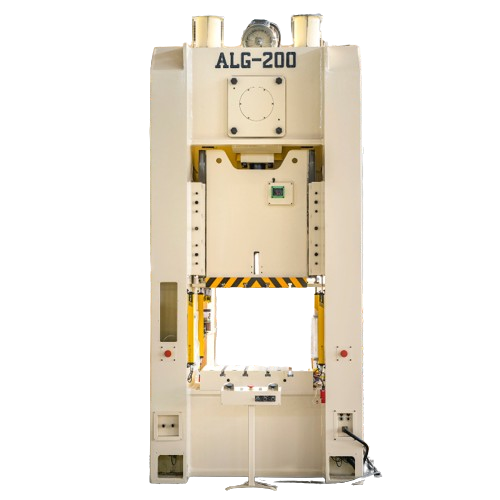
H frame presses use a closed four-column structure to distribute forces evenly across the frame. This design minimizes deflection, maintains slide parallelism, and ensures more stable stamping performance during high-tonnage operations.
Specification | C-Frame (Open-Back) Press | H-Frame (Straight-Side) Press |
|---|---|---|
Frame Design | Open front, C-shaped casting or weldment | Closed loop, 4-pillar construction |
Deflection Profile | Angular deflection ("alligator mouth" gaping) | Symmetrical vertical elongation (maintains parallelism) |
Tonnage Capacity | Typically limited to 200-300 tons max | Scales efficiently from 200 to 3000+ tons |
Die Life Impact | Accelerated wear due to punch misalignment | Extended die life due to strict punch-to-die alignment |
Tooling Access | Three-sided access (front, left, right) | Restricted to front/rear and specific side windows |
Blanking operations, especially with AHSS materials, generate strong reverse forces when the material breaks. This sudden energy release creates shock loads that can damage the frame, tooling, and slide guides if the press lacks sufficient rigidity.
H frame presses are designed to absorb these impacts through heavy steel structures, reinforced crowns, and pre-tensioned tie-rod frames. This rigid construction reduces vibration, protects the tooling system, and improves reliability during high-force blanking operations.
The structural rigidity of the frame is only half of the equation. The drive mechanism dictates how force is applied to the material. This determines the press's suitability for specific applications. Selecting the correct drive technology optimizes stroke rates and manages the unique forming requirements of different metals.
Standard crankshaft drives are widely used for general stamping applications because they provide high speed and reliable performance. However, at high loads, the angled force from the connecting rod can create side pressure on the slide guides, increasing wear.
Eccentric gear drives are better suited for heavy-duty and deep drawing applications. They deliver force more directly through the press frame, providing higher torque during the forming stroke while reducing side loads on the slide. This improves stability, protects the guiding system, and supports demanding high-tonnage operations.
Link-drive systems modify the slide movement by slowing the forming speed during the working stroke and increasing the return speed. This reduces impact on the die, improves material flow during deep drawing, and maintains high production efficiency. Servo presses provide even greater control by using programmable motors to adjust the stroke profile, allowing functions such as bottom dwell for special forming processes. They also improve energy efficiency and reduce mechanical wear through optimized motion control.
Choosing a high-capacity H frame press requires matching machine specifications with production requirements. The right press must provide enough force, stability, and accuracy to support the tooling and material. An incorrect selection may lead to poor part quality, excessive die wear, or production downtime.
Press selection depends on more than maximum tonnage. Tonnage represents the peak force the machine can generate, while energy capacity determines how effectively the press can maintain force during the stroke.
For deep drawing and heavy forming applications, selecting a press only by tonnage may cause insufficient performance. Engineers should also consider:
Required forming force
Energy requirements during the stroke
Die size and weight
Future production expansion
The bed and bolster size must fully support the die to prevent uneven loading. Proper scrap discharge space is also important to avoid material buildup and protect the tooling.
The slide guiding system maintains alignment between the upper and lower dies during stamping.
A standard 4-point guiding system supports the slide at four corners and works well for balanced loads. However, it may have limitations when running large progressive dies with uneven force distribution.
An 8-point gib system provides additional support in both left-right and front-back directions. This improves slide stability, maintains punch and die alignment, and reduces wear during complex stamping operations.
Benefits of 8-point guiding:
Better resistance to off-center loads
Improved part accuracy
Longer die life
More stable progressive stamping performance
Modern H frame presses are designed for automated production lines. Their rigid structure and large working area allow easy integration with:
Servo feeders
Straighteners
Transfer systems
Robotic handling equipment
Before selecting a press, manufacturers should evaluate:
Feed line height
Material opening dimensions
Automation communication systems
Transfer space requirements
Proper integration ensures accurate material positioning and stable high-speed production while reducing feeding errors and tooling damage.
Specific manufacturing sectors drive the demand for high-capacity straight-side presses. In the automotive industry, the shift toward electric vehicles requires the stamping of massive structural components. Battery trays and reinforced chassis brackets demand large bed sizes and exceptional structural rigidity. You have to maintain the tight tolerances required for automated robotic welding downstream. If the stamped part has excessive springback or dimensional variance, the welding robots will fail to strike an arc.
The transition to lighter, harder materials fundamentally changes stamping physics. Aerospace-grade aluminum alloys and AHSS require significantly higher forming tonnages. They generate violent snap-through forces. Only heavily reinforced H Frame Power Presses possess the structural mass and guiding precision necessary to process these advanced materials. Attempting to stamp AHSS on an older, open-frame press will literally tear the machine apart over time.
Choosing a high-capacity H frame press requires balancing equipment cost, production efficiency, and long-term operating benefits. The decision is not only about purchasing a machine but also about improving tooling performance, reducing downtime, and optimizing the entire production process.
A straight-side H frame press requires a higher initial investment than smaller C frame presses. The cost includes machine purchase, transportation, installation, and foundation preparation.
However, the stronger frame structure reduces slide deflection and improves punch-to-die alignment. This helps extend die life, reduce tooling repairs, and lower scrap rates during long-term production.
For manufacturers using expensive progressive dies, the improved accuracy and stability can create significant savings over the machine's service life.
C frame presses provide easier access for tooling changes, while H frame presses focus more on rigidity and high-load performance. Due to their closed structure, H frame presses may require more advanced equipment for heavy die handling.
To improve changeover efficiency, manufacturers can integrate:
Quick Die Change (QDC) systems
Hydraulic die clamps
Pneumatic die lifters
Rolling bolster systems
These solutions reduce setup time and allow one H frame press to handle multiple production tasks efficiently.
Selecting the right manufacturer is as important as choosing the machine specifications. High-tonnage presses are often customized according to production requirements, which means project planning must consider engineering, manufacturing, installation, and testing time.
A reliable supplier should provide:
Technical support during machine selection
Spare parts availability
Installation assistance
Maintenance guidance
Long-term service support
Strong after-sales support helps reduce unexpected downtime and ensures stable operation of critical components such as lubrication systems, clutch and brake units, and hydraulic systems.
A: The primary difference is structural design. A C-frame has an open front, allowing easy tooling access but suffering from angular deflection under high loads. An H-frame features a closed-loop, four-pillar design that eliminates this deflection, maintaining strict parallelism between the slide and bed during operation.
A: Manufacturers typically transition to straight-side presses when operations exceed 200 to 300 tons. Beyond this threshold, the physical limitations of open-frame designs cause excessive deflection, leading to rapid die wear and unacceptable part tolerances.
A: By eliminating angular deflection, the press ensures the punch enters the die cavity perfectly straight every time. This strict alignment prevents the punch from rubbing against the die matrix, drastically reducing wear, preventing edge shearing, and extending the time between required sharpenings.
A: High-tonnage presses require specialized, isolated concrete foundations. This involves excavating a pit, pouring a reinforced concrete inertia block, and installing vibration dampening pads or spring isolators to prevent stamping shockwaves from damaging the factory floor and adjacent equipment.
A: Yes, they are specifically designed for it. The symmetrical four-pillar construction, combined with advanced guiding systems like 8-point gibs, restricts lateral and longitudinal slide movement. This prevents the ram from tilting when progressive dies exert uneven forces across the bed.
A: An 8-point gib system captures the slide at all four corners, controlling movement in both front-to-back and left-to-right directions. This comprehensive guiding provides superior punch-to-die alignment compared to standard 4-point systems, which is critical for complex, multi-station tooling.