
Views: 0 Author: Site Editor Publish Time: 2026-09-21 Origin: Site


Large-panel metal stamping forces a tough choice on the production floor. You either run the line fast and wreck your parts, or run it slow and kill your throughput. Traditional crank and eccentric presses hit the blank hard at high speeds. This aggressive impact tears high-strength steel, wrinkles aluminum, and destroys die coatings. If you slow the ram down to protect the tooling and get a good draw, your strokes per minute drop below profitable levels.
The eight-link motion press fixes this mechanical bottleneck. It changes the slide kinematics entirely. The linkage slows the ram down right before it hits the metal, giving the material time to flow and stretch without fracturing. Once the draw finishes, the ram rips back up to top dead center at high speed. You get the slow drawing speed you need for quality, plus the fast cycle time you need for volume.
Kinematic Control: Eight-Link Motion modifies the slide velocity curve, delivering up to a 40% improvement in metal flow control without sacrificing overall strokes per minute (SPM).
Quality Assurance: Reduced impact speed directly mitigates springback, tearing, and surface marring in large, complex panel geometries, benefiting both deep and shallow draws.
Tooling Longevity: Lower engagement velocities significantly reduce shock and vibration, extending die life and reducing tooling maintenance costs.
Strategic Fit: While requiring a higher initial capital investment than standard mechanical presses, the technology yields superior ROI in high-volume, deep-draw, and progressive stamping applications where scrap reduction is critical.
Table of Contents
An eight-link motion press uses a special linkage system to control slide movement. Unlike traditional crank presses, it can slow the slide during forming and speed up during the return stroke.
This motion control gives the material more time to stretch and flow, reducing tearing and improving part quality while maintaining high production speed.
Traditional presses use a fixed motion pattern. The slide speed changes with the crank rotation, making it difficult to reduce forming speed without lowering production output.
An eight-link system changes this process through a mechanical linkage structure. It slows the slide when the die contacts the material, allowing smoother forming and reducing impact on high-strength materials.
After forming, the slide returns quickly to maintain production efficiency.
Key benefits:
Better metal flow control
Reduced tearing and deformation
Higher production efficiency
For example, a link motion press can run at the same 20 SPM as a standard press while providing a slower forming speed similar to a lower-speed machine.

The faster return stroke creates higher acceleration forces. Therefore, the press structure and automation system must be designed to handle these changes.
Link motion presses require proper coordination with:
Progressive dies
Transfer systems
Automatic feeders
Die protection sensors
The faster upstroke requires accurate timing adjustments. Proper synchronization prevents transfer collisions and ensures stable production.
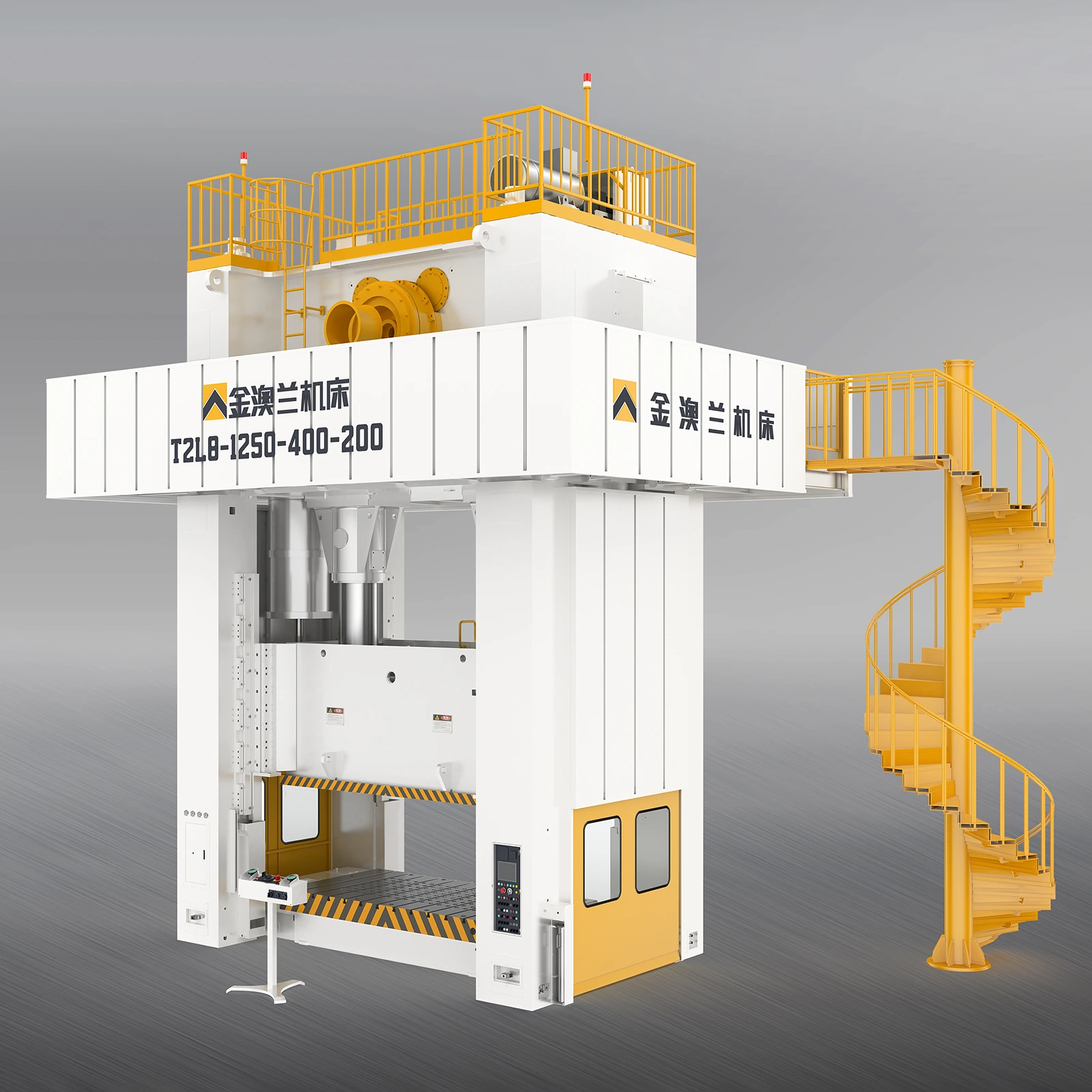
Eight-link motion technology improves stamping quality by controlling slide speed during the forming process. The slower forming stroke helps materials flow smoothly, reduces defects, and improves surface quality.
Large panels, such as automotive parts and appliance housings, require consistent material flow during forming.
Eight-link motion presses slow down the slide when the punch contacts the material. This gives the metal more time to stretch and reduces problems such as:
Material thinning
Tearing
Uneven forming
This advantage is especially important for high-strength steel and aluminum materials, which require more controlled forming conditions.
The controlled motion also improves shallow drawing applications by ensuring better material distribution and more accurate final shapes.
High-strength materials often return partially to their original shape after forming, creating springback issues.
The controlled forming speed of an eight-link motion press applies force more gradually. This helps reduce:
Springback
Wrinkles
Cracks
Dimensional errors
By maintaining stable pressure during the forming stage, manufacturers can achieve more accurate parts with fewer adjustments to the tooling.
Large exterior panels require smooth surfaces and precise details. High impact speed can create surface marks, friction damage, and die wear.
Eight-link motion reduces impact during material contact, helping to:
Protect die surfaces
Reduce surface defects
Improve appearance quality
The longer forming time at the bottom of the stroke also improves embossing and coining performance, allowing sharper details and more accurate features without additional fo
Tooling wear represents a massive operational expense in large-panel stamping. Standard presses generate severe snap-through shock when punching or blanking high-tensile materials. This reverse tonnage sends destructive vibrations through the die, the press bed, and the crown. The modified kinematics of the link drive soften the material engagement, significantly dampening this shock.
Lower impact velocities translate directly to a reduction in punch chipping and die wear. The cutting edges of the tooling do not slam into the material; they shear through it with controlled force. This softer engagement extends the intervals between routine die maintenance. Toolroom technicians spend less time sharpening punches, replacing broken springs, and repairing galled die sections. Over millions of cycles, the reduction in shock and vibration preserves the structural integrity of complex progressive dies and heavy cast-iron die shoes.
Scrap reduction serves as a primary cost-recovery mechanism on the stamping floor. Cutting overall production costs while maintaining quality requires maximizing material yield. Because the slower forming speed prevents tearing and splitting, operators produce fewer rejected panels. This immediate drop in scrap rates directly improves the profitability of each production run.
Improved metal flow allows die designers to implement tighter blank nesting. When the press controls the metal flow effectively, the process requires less excess binder material to hold the sheet in place. Engineers can reduce the overall size of the starting blank. Shaving just a few millimeters of width off a continuous coil of aluminum or advanced high-strength steel yields massive raw material savings over an annual production schedule. You buy less coil weight to produce the exact same number of good parts.
Integrating this technology with medium-to-high volume progressive stamping lines requires careful planning, but yields high efficiency. Progressive dies perform multiple operations sequentially as the metal strip feeds through the press. The modified stroke timing provides a distinct advantage here. The rapid upstroke and slower downstroke alter the traditional feed window.
When properly synchronized, this modified timing provides a larger, more stable window for part transfer. The metal strip has more time to advance and settle into the pilot pins before the punch engages. This stability reduces the risk of misfeeds, pilot hole elongation, and subsequent line stoppages. Operators achieve higher effective throughput because the line runs continuously without sensor faults caused by erratic material feeding or short feeds.
Standard crank and eccentric presses dominate the industry due to their mechanical simplicity. They utilize a straightforward rotary-to-linear motion conversion. This simplicity makes them highly reliable and relatively inexpensive to manufacture. However, their fixed harmonic motion curve forces the slide to hit the material at high velocity when running at high cycle rates.
Link presses introduce a modified curve. The trade-off is clear. Standard presses offer lower upfront costs and simpler maintenance requirements. Yet, they fail to match the part quality, metal flow capabilities, and tool life metrics of link motion systems in complex draws. When stamping deep, large panels, the scrap generated by a standard crank press quickly eclipses its initial cost savings. You end up paying for the cheaper press through rejected parts and broken tooling.
Servo presses represent the ultimate in kinematic flexibility. High-torque servo motors allow operators to program infinite stroke profiles, pausing, reversing, or slowing the ram at any point. You can program a pendulum stroke to run extremely fast on shallow parts. However, this flexibility comes with a massive capital premium, complex electronic architecture, and high energy demands.
An eight-link mechanical press provides a highly effective middle ground. It delivers the specific modified stroke profile necessary for deep drawing and improved metal flow, but at a significantly lower capital cost than a servo press. It relies on robust, traditional mechanical reliability and flywheel energy rather than complex servo drives and capacitor banks. For facilities that run dedicated, high-volume progressive dies where the stroke profile does not need to change daily, the mechanical link drive offers superior ROI.
Feature | Standard Crank Press | Eight-Link Motion Press | Servo Press |
|---|---|---|---|
Slide Kinematics | Fixed harmonic motion | Mechanically modified (slow draw, fast return) | Infinitely programmable profiles |
Impact Velocity | High at production speeds | Significantly reduced | Variable / Fully controlled |
Tool Life Impact | Standard wear and shock | Extended due to low shock | Extended due to low shock |
Maintenance Complexity | Low | Medium (more linkages/pins) | High (complex electronics/cooling) |
Energy Storage | Mechanical Flywheel | Mechanical Flywheel | Capacitor Banks / Direct Drive |
A: The primary advantage is its modified slide velocity curve. The mechanical linkage slows the punch down during the working forming phase, allowing metal to flow without tearing. It then rapidly speeds up during the return stroke. This redefines productivity and precision by decoupling forming speed from overall cycle time.
A: It increases the time available for metal flow by up to 40% during the critical forming phase. This sustained pressure allows the material to stretch evenly over the die geometry. It prevents localized thinning and tearing in deep draws, and eliminates loose metal or wrinkling in shallow, complex draws.
A: No. While the working stroke is significantly slower to protect the material and the tooling, the press compensates with a much faster return stroke. This rapid upstroke ensures the machine maintains, or even increases, the overall strokes per minute (SPM) compared to standard presses.
A: It lowers the impact velocity when the die engages the material. This softer engagement drastically reduces impact shock, destructive vibration, and snap-through forces. By minimizing these violent kinetic transfers, the press prevents punch chipping, reduces galling, and extends the intervals between routine die maintenance.
A: Yes, existing progressive dies are physically compatible. However, operators must adjust feed and transfer timings. The modified slide kinematics create a different operational window. The faster upstroke generates higher lifting forces, requiring transfer automation and sensors to be recalibrated to match the new motion profile.
A: The main disadvantage is mechanical complexity. The system utilizes an increased number of mechanical linkages, connection pins, and bronze bushings compared to a simple crank press. These extra moving parts require strict, automated lubrication systems and rigorous monitoring to prevent wear and maintain slide precision.
A: The faster upstroke generates significantly higher lifting forces and inertia. The slide clears the die space much quicker than a standard press. This requires highly synchronized, rapid transfer automation. Standard mechanical feeders may struggle to keep pace, often necessitating an upgrade to high-speed, servo-driven feeding equipment.