
Views: 0 Author: Site Editor Publish Time: 2026-09-21 Origin: Site


Stamping massive, asymmetrical parts presents a severe engineering challenge. You must manage extreme tonnage across wide bed areas without compromising slide parallelism or part quality. When forming automotive body panels, appliance shells, or large aerospace components, the required force rarely centers perfectly under the ram. This eccentric loading creates immense stress on the press structure. If you underspecify the suspension system, off-center forces lead to premature die wear, unacceptable part tolerances, and catastrophic equipment damage.
Resolving this requires evaluating the fundamental structural differences between press architectures. The choice of a four-point vs two-point press dictates long-term operational viability, tooling lifespan, automation compatibility, and overall equipment effectiveness. Selecting the right configuration ensures the slide remains parallel to the bolster even under severe tipping moments, safeguarding both the tooling and the press frame.
Parallelism Under Load: A Four-Point Press provides superior resistance to slide tipping during severe off-center loading, making it mandatory for massive, asymmetrical parts.
Bed Size Limitations: Two-point presses are generally optimal for left-to-right bed dimensions up to 120-144 inches; exceeding this typically necessitates a four-point architecture to prevent deflection.
Tooling & Automation Strategy: Multi-station transfer dies with heavy unbalanced loads at the ends of the press bed, as well as robotic automation requiring large window openings, require the corner-support mechanics of a four-point system.
Deep Drawing Capabilities: Four-point systems offer superior stability when integrating massive die cushions required for deep drawing large automotive or appliance panels.
Cost vs. Capability: While a four-point press requires a significantly higher initial investment and complex maintenance, it drastically reduces tooling wear and scrap rates in large-panel applications.
Table of Contents
A press suspension system keeps the slide and bolster properly aligned during stamping. It distributes forming forces evenly and reduces deformation under heavy loads.
During stamping, the material pushes back against the slide. Balanced loads are easier to handle, but large or complex parts often create uneven forces. The suspension system helps maintain stability and protect the tooling.
A two-point press uses two drive connections to move the slide. This design provides good stability for standard stamping operations where loads are relatively balanced.
Common applications:
Progressive dies
Standard stamping parts
Balanced production processes
Two-point presses rely on guide systems to reduce slide movement under load. They are cost-effective and suitable for many general stamping applications.
A four-point press uses four drive connections located near the corners of the slide. This design provides better support and improves stability during heavy off-center loading.
Advantages:
Better slide alignment
Higher resistance to uneven forces
Suitable for large and complex parts
Four-point presses are commonly used for deep drawing and large panel stamping. Their advanced drive systems provide stronger force control but require more complex synchronization and maintenance.
Drive Mechanism | Primary Application | Force Delivery Characteristics | Structural Impact |
|---|---|---|---|
Standard Crankshaft | Blanking, shallow forming, high-speed progressive dies. | Delivers peak tonnage very close to bottom dead center (BDC). | Subject to torsional twisting under extreme off-center loads. |
Eccentric Gear | Deep drawing, large panel forming, heavy transfer dies. | Sustains high tonnage higher up in the stroke (e.g., 1/2 inch above BDC). | Eliminates crankshaft twisting; provides massive structural rigidity. |
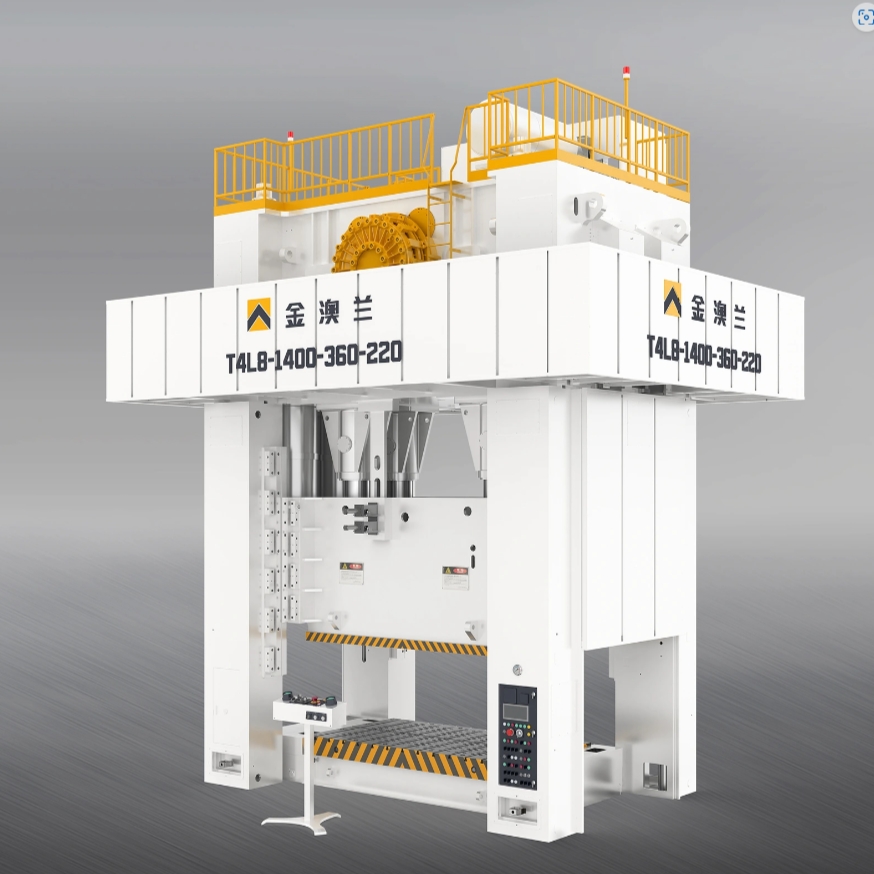
Large parts inherently create off-center loads. Consider forming an automotive door panel. The die might require deep drawing on one end to form the window frame, while the other end only requires shallow trimming for the door edge. The material thickness, draw depth, and required tonnage vary drastically across the die space. This uneven force distribution challenges the structural integrity of the press.
Uneven loading can cause slide tipping and reduce stamping accuracy. When force is concentrated on one side of the die, the slide may lose parallel alignment with the bolster.
Two-point presses mainly rely on guide systems to control slide movement. Under heavy off-center loads, the guide components experience more stress and wear.
Over time, increased clearance can reduce alignment accuracy and affect part quality.
Four-point presses use four drive connections to better balance uneven forces. The support points help maintain slide parallelism without relying only on the guide system.
This makes four-point presses suitable for:
Large stamping parts
Automotive panels
Heavy forming applications
Deep drawing requires precise control of material flow. Die cushions provide upward pressure to help prevent wrinkles and cracks during forming.
Large cushions create significant resistance against the slide. Four-point press designs handle these forces better because the slide receives support from multiple points, maintaining a more stable forming surface.
Poor slide alignment can affect both tooling life and finished part quality.
Common problems include:
Punch Damage: Misalignment increases stress on piercing tools.
Die Wear: Incorrect alignment causes friction and faster tool damage.
Uneven Material Flow: Poor pressure control may cause forming defects.
Cracked Parts: Improper forming can lead to splits or tears.
Automation Problems: Slide movement may interfere with transfer systems.
Higher Scrap Rate: More defective parts increase production costs.
Maintaining proper slide alignment helps extend die life, improve product consistency, and reduce downtime.
Selecting the correct architecture requires a strict technical evaluation. Engineers must compare the two systems across critical production metrics to ensure the machine matches the tooling requirements. You cannot simply look at total tonnage; you must evaluate how the press handles that tonnage across its physical dimensions.
Technical Metric | Two-Point Press | Four-Point Press |
|---|---|---|
Standard Bed Width Limit | Up to 144 inches | 144 inches to 300+ inches |
Off-Center Load Capacity | Moderate (relies heavily on gibs) | High (relies on corner pitmans) |
Front-to-Back Stability | Limited by pitman width | Excellent corner support |
Automation Window Size | Standard (often restricts large robots) | Oversized (ideal for 3-axis transfer systems) |
Ideal Tooling Type | Centered Progressive Dies | Large Transfer & Panel Dies |
Engineering thresholds dictate the practical limits of press design. A two-point press becomes structurally inadequate when the left-to-right dimension exceeds approximately 144 inches. Beyond this width, the span between the two pitmans becomes too great. The slide will inevitably bow in the center under heavy loads, regardless of how thick the casting is.
Front-to-back dimensions also play a critical role. Wide front-to-back beds almost always require a four-point press. A two-point connection cannot provide sufficient rigidity across a deep bed. The slide will tip forward or backward if the load shifts away from the exact center line. For example, stamping a large appliance shell requires a deep bed to accommodate the draw station, making a four-point configuration mandatory.
Deflection curves highlight the differences between the two systems. Press manufacturers rate deflection in thousandths of an inch per foot of bed length. Under maximum rated eccentric loads, a two-point slide exhibits a steeper deflection curve at the unsupported corners. The material yields slightly, and the parallelism suffers, leading to the tooling issues mentioned earlier.
Gib clearances dictate how much a slide can tip before the frame stops it. A four-point press reduces the lateral stress placed on the guiding system. Because the corner connections hold the slide flat, the gibs merely guide the vertical motion rather than fighting severe tipping forces. This extends the life of the press frame, reduces the frequency of gib adjustments, and maintains tighter tolerances over decades of heavy use.
Transfer dies represent the ultimate test of press stability. In a transfer operation, individual parts move from station to station across the bed via automated transfer bars. Station one might perform a deep draw requiring 800 tons, while station five performs a final trim requiring only 50 tons. This creates a massive load imbalance from left to right.
This unbalanced nature necessitates four-point stability. The massive off-center load at the drawing station will violently tip a two-point slide. The corner-support mechanics of a four-point system absorb this localized tonnage, keeping the entire slide parallel so the trimming stations operate cleanly. If the slide tips in a transfer press, the timing of the transfer bars will desynchronize with the die space, leading to misfeeds.
Progressive dies present a different scenario. A two-point press is usually sufficient for progressive applications because the continuous strip balances the load across the bed. However, heavy-duty progressive dies stamping thick, high-tensile steel across wide beds may still require a four-point architecture to prevent center bowing and manage the severe reverse tonnage (snap-through) generated when punching thick materials.

Modern stamping relies heavily on automation. The structural differences in the press frame dictate how easily you can integrate robotic systems. Four-point presses typically feature much wider uprights to accommodate the massive corner pitmans and eccentric gears.
These wider uprights allow for larger window openings. Large windows facilitate easier integration of robotic part transfers, massive scrap removal conveyors, and automated quick die change (QDC) systems. A two-point press often has narrower windows, restricting the size of the automation equipment that can pass through the frame. When specifying a press for a fully automated line, the window clearance is just as critical as the bed size.
Evaluating press architecture requires looking beyond the initial installation. The long-term operational footprint, maintenance complexity, and energy requirements heavily influence the viability of the stamping line. You must account for the physical realities of housing and maintaining these massive machines.
Massive presses require massive foundations. A four-point crown is significantly heavier and wider than a two-point crown. This extra structural mass demands deep foundation pits, extensive concrete reinforcement, and specialized vibration isolation systems. A 2000-ton four-point press might require a pit 20 feet deep, lined with heavily reinforced concrete and featuring sump pumps for oil recovery.
Facility overhead clearance is another critical factor. The towering height of a four-point eccentric gear drive often requires raising the factory roof or excavating a deeper pit to keep the pass-line height ergonomic. Rigging a four-point press involves specialized gantry cranes and complex logistics to maneuver the massive crown, uprights, and slide castings into place. The facility must have the structural capacity to support these rigging operations.
Maintenance complexity scales with the number of moving parts. A four-point system has twice as many connections, wrist pins, bearings, and gears as a two-point system. Maintenance teams must lubricate, monitor, and eventually rebuild double the components. The slide adjustment mechanism is also more complex, requiring a synchronized chain or gear drive to ensure all four pitman screws adjust simultaneously without binding.
However, this mechanical complexity pays off in tooling longevity. The rigid parallelism of a four-point system drastically reduces die wear. Punches stay sharp longer, and die sections avoid galling. The reduction in die maintenance and unplanned press downtime often offsets the higher mechanical maintenance demands of the press itself. You spend more time maintaining the press, but significantly less time pulling dies out for emergency repairs.
Servo-driven technology alters the traditional mechanical press landscape. High-torque servo motors replace the massive flywheels and clutches of standard mechanical presses. A four-point servo press represents the ultimate solution for large, complex parts, combining structural rigidity with infinite stroke control.
Servo technology offers unmatched slide control combined with programmable stroke profiles. You can slow the slide down precisely at the point of impact, perform multiple strikes at the bottom of the stroke, and optimize the drawing speed for advanced high-strength steels. When combined with a four-point suspension, a servo press delivers perfect parallelism and infinite forming flexibility, completely eliminating the shock of impact while maintaining full tonnage.
To ensure optimal press selection and facility readiness, execute the following next steps:
Conduct a comprehensive tonnage and off-center load analysis of your heaviest, most complex dies using existing production data.
Measure the required left-to-right and front-to-back bed dimensions needed to accommodate your largest automated transfer systems and scrap chutes.
Install 4-channel tonnage monitors on your current equipment to baseline the severity of eccentric loading on your shop floor.
Evaluate your current scrap rates and die maintenance logs to identify recurring issues caused by slide tipping or gib wear.
Schedule a technical engineering review to map your specific forming requirements to the appropriate press frame and suspension design.
A: Typically, when the left-to-right dimension exceeds 120-144 inches, or when the front-to-back dimension is exceptionally wide, requiring corner support to prevent slide bowing.
A: Yes, but only for smaller parts where the off-center loads at the first and last stations do not exceed the press's rated eccentric load capacity and gib strength.
A: It causes the slide to tip, putting massive lateral force on the gibs, uneven wear on the pitman connections, and can eventually crack the press frame or slide.
A: Large die cushions exert massive upward force during deep drawing. A four-point press distributes this counter-force more evenly across its four corner connections, preventing the slide from bowing upward in the center, which is a risk in wide two-point presses.
A: Mechanically, yes, due to having double the connections, gears, and bearings. However, it often reduces overall maintenance costs by drastically extending die life.
A: Yes, it is highly recommended to have a 4-channel tonnage monitor to ensure the load is distributed within safe limits across all four connections, preventing hidden overloads.
A: Four-point and two-point configurations are almost exclusively found in straight-side presses, as gap-frame (C-frame) presses are structurally unsuited for the massive tonnages and bed sizes discussed here.