
Views: 0 Author: Site Editor Publish Time: 2026-02-10 Origin: Site


A Power Press is a cornerstone machine in modern manufacturing, shaping, cutting, bending, and punching metals with precision. Whether you call it a mechanical press, stamping press, or simply a press machine, it plays a key role in automotive, electronics, and appliance production. Understanding how a power press works, its types, and applications can help you choose the right equipment for your workshop or production line. Let’s explore everything you need to know about this versatile industrial machine.
A power press is a type of machine that applies force to shape, cut, punch, or bend materials. They can run on mechanical, hydraulic, or pneumatic energy. People also call them press machines, stamping presses, or mechanical presses.
They are widely used in factories, workshops, and assembly lines. Small presses can remove bearings or shape tiny parts. Large presses can stamp car body panels or metal sheets for appliances.
Key points about power presses:
They use repeated force to form materials.
They can handle thin or thick sheets depending on type.
They work with dies to create precise shapes.
Mechanical presses use a motor and flywheel to drive the ram. The flywheel spins continuously, storing energy. When the clutch engages, the crankshaft and connecting rods move the slide downward.
Key features:
High stroke speed: 100–400 strokes per minute
Precision: best for medium and thin metal sheets
Force: sudden impact, not ideal for very delicate parts
The motion sequence:
Motor spins flywheel, storing energy
Clutch engages, crankshaft transfers motion
Slide moves down along guides
Upper die presses material into the lower die
Slide returns, next piece is fed
Mechanical presses are cost-effective and easy to maintain. They do produce more noise and vibration, so proper setup is essential.
Pneumatic presses run on compressed air. They use a pneumatic clutch and brake system to move the slide. Air pressure controls the speed, making it smooth and adjustable.
Differences from mechanical presses:
Safety: softer, controlled strokes
Noise: quieter operation
Vibration: minimal
Force: less impact, not ideal for very thick sheets
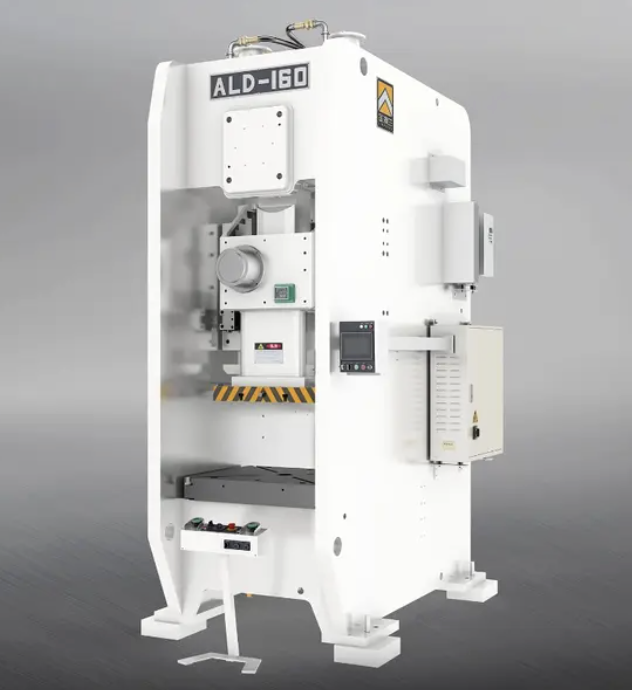
Power presses are usually classified by how they generate force. Understanding the driving force helps you choose the right machine for your task.
Mechanical Power Press
Uses an electric motor to spin a flywheel. Energy transfers through a crankshaft and connecting rods to move the ram. Best for thin to medium metal sheets. Fast and efficient, but sudden force can make precise work challenging.
Hydraulic Press
Uses hydraulic cylinders and pressurized oil to move the ram. Offers adjustable pressure and smooth strokes. Ideal for deep drawing, thick materials, or hot pressing. Slower than mechanical presses, but highly precise.
Pneumatic Press
Operates using compressed air. Stroke speed and pressure are adjustable. Quieter and safer than mechanical presses, with low vibration. Best for automated or repetitive tasks requiring controlled impact.
| Press Type | Force Source | Best For | Stroke Speed | Precision |
|---|---|---|---|---|
| Mechanical | Flywheel + Motor | Thin/medium metal | High | Medium |
| Hydraulic | Hydraulic Oil | Deep drawing, thick metal | Low | High |
| Pneumatic | Compressed Air | Automation, safety-critical | Medium | Medium-High |
The slider, or ram, can move in one or more actions depending on press design.
Single-action press – One ram stroke per cycle. Most common in workshops and small-scale production.
Double-action press – Two rams or movements per cycle. Mostly used for automotive panels and larger metal parts.
Triple-action press – Three movements per cycle. Rare, mostly in large-scale manufacturing for specialized parts.
This classification ensures the machine matches the complexity of the forming or punching operation.
Presses can also be categorized based on how the slider is driven. Each mechanism offers unique advantages:
Crank Press – Uses a crankshaft to move the slide. Common in mechanical presses, fast and reliable.
Crankless Press (Eccentric Gear) – No crankshaft; uses eccentric gears. Reduces vibration and increases precision.
Knuckle Press – Link mechanism amplifies force at bottom stroke. Good for thick or tough materials.
Friction Press – Uses friction drive and screw mechanism. Adjustable stroke, ideal for variable operations.
Screw Press – Rotating screw drives ram downward. Smooth, precise force application.
Rack Press – Gear rack mechanism moves slider. Often used for continuous production tasks.
Link Press – Mechanical links control motion. Offers high precision and repeatability.
Cam Press – Cam system drives slider. Customizable motion profiles for special stamping or shaping.
| Slider Mechanism | Key Feature | Common Use |
|---|---|---|
| Crank Press | Fast, reliable | Sheet metal stamping |
| Crankless Press | Smooth, low vibration | Precision parts |
| Knuckle Press | Amplified force | Thick material forming |
| Friction Press | Adjustable stroke | Multi-purpose operations |
| Screw Press | Precise control | Forging, pressing |
| Rack Press | Continuous production | Medium-scale lines |
| Link Press | Repeatable motion | Precision stamping |
| Cam Press | Custom motion | Specialized parts |
Mechanical presses rely on a set of key components to operate efficiently and safely.
Frame / Base – Supports the entire press and absorbs reaction forces during operation. Stability is critical for accuracy.
Flywheel – Stores rotational energy from the motor. Delivers consistent power to the ram during each stroke.
Slide / Ram – Moves up and down to press material. Its motion determines stroke length and forming force.
Crankshaft & Connecting Rod – Convert circular motion of the flywheel into linear motion of the ram.
Die Set / Tooling – Shapes the material into the desired profile. Can be swapped for different tasks.
Clutch & Brakes – Start and stop the ram precisely. Essential for safe operation.
Electrical Control System – Includes sensors, overload protection, and emergency stops. Monitors machine operation.
| Component | Function | Importance |
|---|---|---|
| Frame / Base | Structural support | Accuracy, safety |
| Flywheel | Energy storage | Consistent stroke |
| Slide / Ram | Pressing motion | Material forming |
| Crankshaft & Rod | Motion conversion | Stroke control |
| Die Set | Shapes material | Versatility |
| Clutch & Brakes | Motion control | Operator safety |
| Electrical System | Monitors operation | Prevents damage, accidents |
Pneumatic presses replace some mechanical parts with air-driven components for smoother operation.
Air Cylinder – Powers the slide using compressed air. Speed and force can be adjusted.
Solenoid Valve – Controls air flow to the cylinder. Enables precise operation and timing.
Flow Control Valve – Adjusts stroke speed, ensuring gentle or rapid pressing as needed.
Air Tank – Stores compressed air, stabilizing pressure during operation.
PLC Controller / Automation Interface – Manages machine logic, integrates safety features, and controls feeding lines.
| Component | Function | Benefit |
|---|---|---|
| Air Cylinder | Moves slide | Adjustable, smooth strokes |
| Solenoid Valve | Controls air flow | Precision and timing |
| Flow Control Valve | Adjust stroke speed | Adaptable to tasks |
| Air Tank | Air storage | Stable operation |
| PLC Controller | Machine logic & automation | Safety and efficiency |
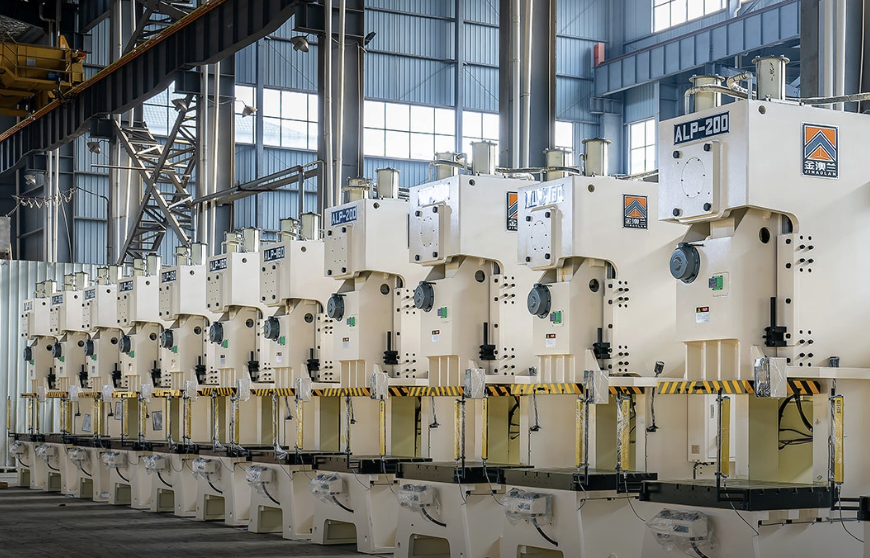
Power press machines are extremely versatile and used across many industries. They handle a range of materials, including steel, aluminum, copper, and even some plastics.
Power presses shape critical car components efficiently.
Body panels – stamping sheet metal into precise curves.
Brackets & mounts – bending and punching holes for assemblies.
Door frames – forming strong, consistent structural pieces.
| Component | Material | Typical Operation |
|---|---|---|
| Body panel | Steel, Aluminum | Stamping & bending |
| Brackets | Steel | Punching & forming |
| Door frame | Aluminum | Bending & cutting |
Small, precise components are easily produced using presses.
Connectors & pins – thin metal sheets punched into connectors.
Casings & enclosures – metal or plastic panels shaped consistently.
Key benefits: high repeatability, tight tolerances, suitable for mass production.
Press machines make hardware and panels for everyday appliances.
Panels – front and back covers of washing machines, ovens, or microwaves.
Hardware & enclosures – hinges, brackets, and protective covers.
They improve efficiency and reduce manual labor for consistent quality.
Hardware for construction and furniture relies on pressed parts.
Hinges & lock bodies – formed from steel or brass sheets.
Faucet parts & supports – small but precise components for kitchens and bathrooms.
Press machines allow repeatable accuracy and strong, durable parts.
High-precision components are critical in aerospace and defense.
Stamped panels & brackets – lightweight aluminum, titanium, or stainless steel.
Precision parts – require strict tolerances for safety and performance.
This industry benefits from presses for consistent quality and low material waste.
| Industry | Example Parts | Material Used |
|---|---|---|
| Automotive | Body panels, brackets, door frames | Steel, aluminum |
| Electronics | Connectors, pins, casings | Copper, steel, plastics |
| Home Appliances | Panels, enclosures, hardware | Steel, aluminum |
| Construction & Furniture | Hinges, lock bodies, faucet parts | Steel, brass, aluminum |
| Aerospace & Defense | Stamped components, brackets | Aluminum, titanium, stainless steel |
A: Mechanical presses use a motor and flywheel for fast, repeated strokes, ideal for thin or medium sheets. Hydraulic presses use pressurized oil for smooth, adjustable strokes, perfect for thick, deep-drawn, or precision parts.
A: Yes, power presses can process steel, aluminum, copper, and some plastics, but force, die selection, and stroke settings must match material properties.
A: Regular maintenance, proper lubrication, timely inspection of die and components, and using the machine within rated capacity extend lifespan.
A: Small presses risk pinch points and operator error; industrial presses require strict training, guards, emergency stops, and routine inspections due to high force and size.
Power presses transform raw materials into finished components faster and more accurately than manual methods. From stamping car panels to crafting precise electronic connectors, they offer unmatched efficiency across industries. Choosing the right type—mechanical, hydraulic, or pneumatic—can boost productivity while ensuring safety and quality.
If you’re looking for reliable, high-performance press machines, Zhejiang Jinaolan Machine Tool Co., Ltd. provides advanced solutions designed for versatility and durability. Explore their range to find a power press that fits your production needs and scales with your business growth.