
Views: 0 Author: Site Editor Publish Time: 2026-09-21 Origin: Site


In mechanical stamping, the motor does not supply the direct force to form the metal. Instead, the motor's primary job is to restore energy to the power press flywheel between strokes. Mismatched flywheel dynamics carry severe operational consequences for any production floor. An incorrectly sized rotor leads to press stalling, premature clutch wear, excessive motor strain, inconsistent part accuracy, or inadequate energy delivery at the bottom of the stroke. You need a technical framework for evaluating flywheel mass, diameter, operating speed, and material design. This ensures the selected Power Press aligns with specific manufacturing applications, from high-speed blanking to deep drawing. We will break down the physics, material choices, and drive train compatibility requirements to keep your stamping lines running without catastrophic failure.
Energy Storage Dictates Application: A power press flywheel stores kinetic energy; heavier, larger flywheels are required for deep-draw operations requiring sustained energy, while lighter flywheels suit high-speed, short-stroke blanking.
Mass vs. Speed Trade-off: Kinetic energy scales linearly with mass but exponentially with speed. Optimizing flywheel diameter and RPM is often more efficient than simply adding raw weight.
Stamping Accuracy and Consistency: A properly sized flywheel maintains constant energy release, preventing micro-stalling or speed fluctuations during the stroke that can compromise the dimensional accuracy of the stamped part.
Drive Train Compatibility: Flywheel size directly impacts motor slip requirements and clutch/brake thermal capacity; over-sizing the flywheel without upgrading the drive train causes rapid component failure.
Recovery Time is Critical: The time available between strokes dictates the maximum allowable flywheel energy depletion (typically 10-15% for continuous operations).
Table of Contents
A power press flywheel stores energy and releases it during the stamping process. The motor provides continuous power, while the flywheel delivers the high energy required for the short forming stroke.
The flywheel helps maintain stable speed, reduce motor load, and prevent sudden power fluctuations during stamping.
Flywheel performance depends on both weight and rotational speed. Increasing the diameter or RPM can improve energy storage more efficiently than simply adding weight. A properly designed flywheel provides enough energy while reducing stress on the motor, bearings, and machine frame.

The moment of inertia depends heavily on exactly where the mass is located relative to the center of rotation. Rim-heavy designs intentionally concentrate weight at the outer edge of the wheel. This specific configuration maximizes inertia without adding unnecessary bulk to the center hub. Solid discs distribute mass evenly across the entire radius, which inherently lowers the overall energy storage efficiency per pound of material used.
Increasing the diameter yields a significantly higher energy capacity. It achieves this without proportionally increasing the static load on the main shaft bearings. A larger diameter pushes the heavy mass further from the axis of rotation. This geometric shift multiplies the stored energy effectively. Operators gain substantial punching power while protecting the internal bearings from excessive dead weight. Optimizing the diameter-to-mass ratio is the most effective way to engineer a highly responsive stamping system.
Design Type | Mass Distribution | Energy Efficiency | Bearing Load Impact | Best Application |
|---|---|---|---|---|
Rim-Heavy | Concentrated at the outer edge | High (Maximum inertia per pound) | Low to Moderate | Standard stamping, general blanking |
Solid Disc | Evenly distributed across radius | Moderate | High | High-speed, short-stroke operations |
Spoked | Rim-heavy with connecting arms | High | Low | Slower, deep-draw mechanical presses |
Traditional cast iron flywheels remain common in older machinery and slower operations. Cast iron absorbs vibration well and is cost-effective to manufacture. However, modern high-performance applications demand fabricated steel or specialized alloy rotors. Cast iron has lower tensile strength and a brittle grain structure. This makes it vulnerable to centrifugal fragmentation at high speeds. If a cast iron wheel spins past its rated RPM, it can shatter like glass, sending lethal shrapnel across the shop floor.
Steel alloys tolerate much higher rotational velocities safely. This allows the machine to store more energy in a smaller physical footprint. Material tensile strength dictates the maximum safe operating speed of the component. These RPM limits directly control the maximum energy density of the entire system. Solid web designs offer heavy-duty structural integrity under severe high-speed centrifugal stress. Spoked designs save overall weight but introduce stress risers at the spoke junctions where cracks can propagate over time. High-speed stamping demands solid steel rotors to prevent mechanical failure while maximizing the available energy density for rapid cycling.
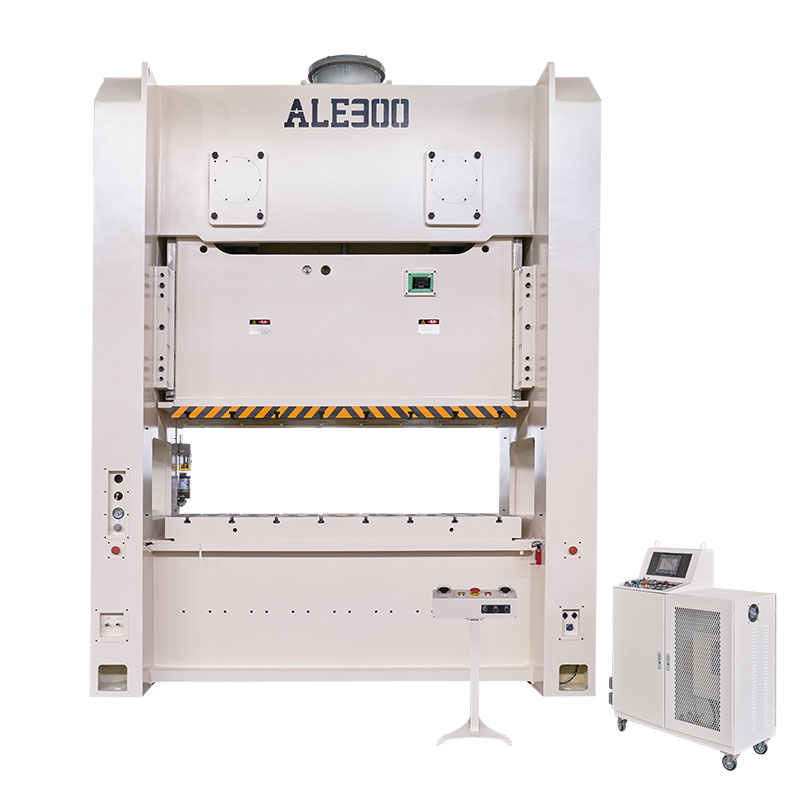
Flywheel selection depends on the stamping process. Heavy flywheels provide higher energy storage for demanding forming operations, while lightweight flywheels support faster production speeds.
Heavy flywheels store more kinetic energy and maintain stable force during demanding stamping processes.
They are suitable for:
Deep drawing
Thick plate forming
Heavy-duty stamping
The higher inertia helps prevent speed drops during the forming process and improves part consistency.
However, heavy flywheels require:
Higher motor power
Stronger clutch and brake systems
Longer acceleration and stopping time
They are ideal for applications where forming force is more important than production speed.
Lightweight flywheels are designed for fast cycling and quick energy recovery.
They are commonly used for:
High-speed blanking
Thin sheet stamping
Short-stroke operations
Their lower inertia allows faster acceleration and shorter recovery time, improving production efficiency.
The limitation is lower energy capacity. When used for heavy materials or deep forming, lightweight flywheels may experience speed loss, reduced accuracy, and increased motor load.
Feature | Heavy Flywheel | Lightweight Flywheel |
|---|---|---|
Energy Storage | High | Lower |
Production Speed | Moderate | High |
Recovery Time | Longer | Faster |
Best Application | Deep drawing, heavy forming | Blanking, high-speed stamping |
Motor Requirement | Higher power | Lower power |
Choosing the correct flywheel depends on the balance between energy demand and production speed.
High-speed blanking requires lightweight flywheels running at exceptionally high RPMs. The working distance of the stroke in these applications is very short. The punch contacts the material and shears it in a fraction of a second, usually within the last eighth of an inch of the stroke. Rapid energy recovery takes absolute priority over total energy capacity. The system must hit the material, snap through, and immediately prepare for the next stroke. You are looking at machines running anywhere from 200 to 1000 strokes per minute.
The motor must restore the depleted energy instantly to maintain the production rate. A heavy rotor would fail to accelerate quickly enough between these rapid strokes, causing the machine to lose speed progressively. Fast clutch response is also critical for high-speed coining operations. Lightweight rotors minimize the thermal load on the clutch plates. This allows the equipment to maintain tight tolerances and consistent force at hundreds of strokes per minute without burning up the friction discs.
Deep drawing necessitates large, high-inertia flywheels to sustain force over a long distance. The extended working distance of a draw operation pulls a massive amount of energy from the system continuously. A single deep draw can easily deplete up to 20% of the stored energy in one smooth motion. The machine must push the material into the die steadily without hesitation. The engagement starts high up in the stroke window, meaning the wheel is bleeding off energy for a much longer duration than a simple blanking hit.
Significant mass is required to prevent the machine from stalling before reaching bottom dead center. If the rotor lacks sufficient inertia, the punch slows down during the draw phase. This speed fluctuation causes severe material tearing, wrinkling, and high rates of rejected parts. A heavy rotor guarantees smooth, unstoppable force through the entire depth of the form. It ensures the metal flows plastically without fracturing.
Application Parameter | High-Speed Blanking | Deep Drawing |
|---|---|---|
Working Distance | Very short (bottom of stroke) | Long (starts high in stroke) |
Energy Depletion per Stroke | Low (typically under 10%) | High (up to 20%) |
Required Flywheel Mass | Lightweight | Heavy, high-inertia |
Operating RPM | High | Low to Moderate |
Motor Recovery Time | Milliseconds | Seconds |
Selecting a flywheel requires evaluating the press speed, motor compatibility, and drive system capacity. A properly matched flywheel ensures stable energy delivery, consistent stamping quality, and longer equipment life.
The press stroke rate directly affects how quickly the flywheel can recover energy between cycles.
High-speed stamping: Requires faster energy recovery and lighter flywheels.
Heavy forming: Requires higher energy storage and larger flywheels.
If the flywheel cannot recover energy fast enough, the press may lose speed, reduce forming accuracy, or overload the motor. The flywheel size and motor power must be matched to the production speed and stamping requirements.
The motor must work together with the flywheel to handle sudden stamping loads.
High-slip motors are commonly used in power presses because they can handle temporary speed changes during the forming process. This allows the flywheel to release stored energy without placing excessive stress on the motor.
Using an unsuitable motor can cause higher current demand, overheating, and premature failure.
Flywheel weight directly affects clutch and brake performance.
Heavy flywheels store more energy but require stronger clutch systems to transfer power safely. The brake must also provide enough stopping force to control the additional momentum during emergency stops.
Before upgrading or replacing a flywheel, always verify:
Clutch capacity
Brake capacity
Motor power
Safety stopping distance
A balanced drive system ensures reliable operation and maintains production safety.
Audit your primary stamping operations by documenting material thickness, stroke length, required strokes per minute, and acceptable part tolerances before selecting equipment.
Consult with equipment manufacturers to perform a formal energy calculation that maps the tonnage versus energy curve for your specific dies.
Execute a complete drive-train audit to verify motor slip ratings, clutch torque capacity, and brake thermal limits before attempting any retrofits.
Recalibrate all safety light curtains and two-hand controls to match the specific stopping distance of the new configuration to maintain strict OSHA compliance.
Implement a routine inspection schedule to monitor clutch friction wear and motor operating temperatures, ensuring the energy recovery system remains balanced.
A: It stores kinetic energy generated by the motor and releases it instantaneously to provide the necessary force during the working portion of the press stroke. This prevents the motor from absorbing the massive shock load of the metal forming process.
A: Heavier flywheels take longer to accelerate and recover lost RPM, making them suitable for slower, high-energy operations. Lighter flywheels allow for faster clutch engagement and higher Strokes Per Minute (SPM) but deliver less total energy per stroke.
A: Yes. An under-sized flywheel may experience excessive speed drops during the stroke, leading to inconsistent force application and dimensional inaccuracies in the final part. Smooth, continuous momentum is required for precise material flow.
A: While possible, changing flywheel mass requires a comprehensive engineering review. Increasing mass without upgrading the motor, clutch, and brake will lead to mechanical failure and safety compliance issues regarding stopping distances.
A: Tonnage is the maximum structural force the press can exert, while flywheel energy dictates how far up the stroke that force can be sustained without stalling the machine. High tonnage requires high energy to maintain force over a distance.
A: High-slip motors are designed to intentionally slow down under load, allowing the power press flywheel to release its stored energy without the motor drawing excessive current and overheating. Standard motors would burn out under these cyclical shock loads.