
Views: 0 Author: Site Editor Publish Time: 2026-10-12 Origin: Site


Miscalculating press capacity carries severe financial and operational risks. Undersizing a machine leads to catastrophic frame failure, stalled motors, and shattered tooling. Oversizing results in wasted capital expenditure and excessive energy consumption. Plant managers and manufacturing engineers face a strict balancing act. You must align current production requirements with future scalability without overcapitalizing. Material yield strength, part dimensions, and tooling complexity all dictate your equipment needs.
We will break down a technical framework for power press tonnage selection. This guide evaluates the operational thresholds, facility requirements, and application limits of a 200-Ton Power Press compared to 400-ton and 600-ton alternatives. You will learn how to match machine specifications to die requirements, control frame deflection, and plan for heavy-duty facility infrastructure.
Tonnage Calculation Requires a Buffer: Always calculate the baseline tonnage required for the specific material and operation, then add a minimum 20% safety margin to account for tool wear and material variation.
Match Tonnage to Tooling, Not Just Material: Progressive dies and off-center loading require significantly higher tonnage and frame rigidity than simple, single-station blanking.
Facility Infrastructure Dictates Feasibility: Upgrading from a 200-ton to a 400-ton or 600-ton press fundamentally changes floor loading requirements, often necessitating custom foundation pits and specialized rigging.
Deflection is the Enemy of Precision: Higher tonnage presses are required not just for sheer force, but to minimize frame deflection when working with high-tensile materials, ensuring part consistency and extending die life.
Control Systems Drive Value: Beyond raw power, modern consistent pressure control and ease of operation dictate the long-term ROI of heavy-duty presses.
Table of Contents
Press tonnage calculation starts with the cutting perimeter, material thickness, and shear strength. For blanking and punching, the basic formula is Force = Cutting Perimeter × Material Thickness × Shear Strength. This provides an initial force estimate, which must be adjusted for tooling conditions, material variations, and actual production requirements.
Material thickness, strength, and forming depth directly affect stamping press tonnage requirements. Thicker metals and high-strength steels generally require greater forming force, while deep drawing also demands sufficient stroke length and blank-holder control. Engineers should evaluate material properties, forming complexity, and required force throughout the stroke before selecting press capacity.
A 20%–30% capacity margin can serve as a preliminary guideline when selecting stamping press tonnage. For example, a 160-ton forming requirement may justify considering a 200-ton press. This margin helps accommodate material variations, tooling wear, and changing production conditions. Final selection must also verify the press force curve, available energy, and manufacturer specifications.
Reverse tonnage, also called snap-through shock, occurs when stored energy is suddenly released during material fracture in blanking or punching. Excessive shock can damage press frames, tooling, and drivetrain components. Proper press selection, rigid frame construction, and suitable shock-damping systems help reduce vibration, equipment wear, and maintenance costs.
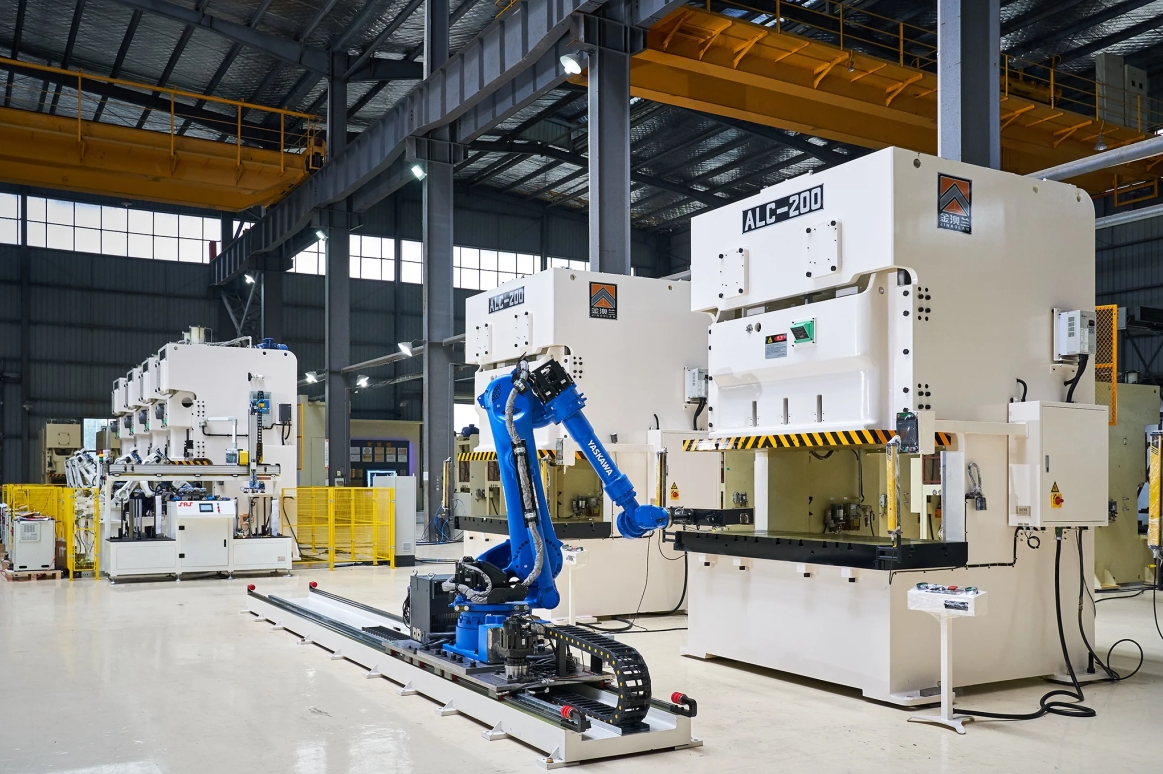
200-ton stamping presses are suitable for medium-duty blanking, punching, piercing, and shallow forming operations. Common applications include automotive brackets, electrical enclosures, appliance components, and general sheet metal parts. They offer a practical balance of forming capacity, machine size, and production efficiency for many industrial manufacturers.
200-ton presses typically accommodate small to medium-sized dies, depending on bed dimensions and frame design. Large progressive dies or uneven loading may exceed the machine's allowable capacity and cause slide deflection or tooling misalignment. Engineers should verify bed size, ram dimensions, die clearance, and off-center load limits before selecting equipment.
200-ton mechanical presses can offer relatively high strokes per minute (SPM), making them suitable for repetitive, high-volume stamping operations. Automated feeders and material straighteners help maximize productivity. However, actual production speed depends on press design, stroke length, tooling complexity, and forming requirements rather than tonnage alone.
Upgrading from a 200-ton to a 400-ton press is suitable when production involves thicker materials, high-strength steel, or complex progressive dies. A 400-ton press provides greater forming capacity for simultaneous blanking, piercing, and bending operations. The upgrade should be based on calculated tonnage requirements, die dimensions, and production demands.
400-ton presses with rigid frames and advanced slide guiding systems can better manage uneven loads generated by progressive dies. Proper load distribution helps reduce ram deflection, tooling misalignment, and premature die wear. Engineers should verify the machine's allowable off-center loading capacity to maintain stamping accuracy and equipment reliability.
Straight-side press frames offer high structural rigidity and improved deflection control for heavy-duty stamping. Reinforced uprights, preloaded tie rods, and precision slide guides help maintain ram-to-bed parallelism under load. This stability improves dimensional accuracy, reduces burr formation, and extends tooling service life.
600-ton stamping presses are commonly used for large automotive components, heavy appliance parts, and complex metal forming operations. Their high tonnage capacity supports demanding applications involving thick materials, large dies, and deep drawing. Proper force control helps maintain material flow and reduce forming defects.
Stroke length, shut height, and die space are critical when selecting a 600-ton press. Large or deep-drawn components require sufficient ram travel, tooling clearance, and part removal space. Engineers should verify die dimensions, slide adjustment range, and automation clearance to ensure efficient production and safe operation.
600-ton presses require careful balancing of forming capacity, stroke speed, and energy consumption. Mechanical presses offer efficient repetitive operation, while servo-driven systems provide adjustable motion profiles for improved forming control. Optimizing ram speed and automated material handling can improve production throughput and reduce unnecessary energy consumption.

Mechanical presses deliver high production speeds and are generally suited for blanking, punching, and shallow forming. Hydraulic presses provide controllable force throughout the stroke, making them suitable for deep drawing and complex forming. Selecting the right actuation system depends on forming depth, speed requirements, and production volume.
Press bed and ram dimensions must accommodate the tooling footprint and provide adequate load support. Incorrect die matching can cause uneven force distribution, tooling deformation, and inconsistent part quality. Engineers should verify bolster dimensions, slide size, clamping arrangements, and die clearance before purchasing equipment.
Press Capacity | Typical Frame Type | Suitable Applications | Production Speed |
|---|---|---|---|
200 Ton | C-Frame / Straight-Side | Blanking, shallow forming | Generally higher |
400 Ton | Straight-Side | Progressive dies, medium forming | Medium |
600 Ton | Heavy Straight-Side / Hydraulic | Deep drawing, large panels | Generally lower |
Actual stroke speed and forming capability depend on press design, drive technology, tooling, and operating conditions.
Stroke length determines the ram's travel distance, while shut height defines the available tooling space at the bottom of the stroke under specified adjustment conditions. Both parameters must match die height, forming depth, and part removal requirements. Proper clearance prevents tooling interference and supports efficient stamping operations.
Modern stamping presses use PLC controllers, HMI interfaces, and monitoring systems to improve operational accuracy and efficiency. Features such as programmable motion control on compatible drives, recipe storage, tonnage monitoring, and fault diagnostics help reduce setup time, prevent overloads, and maintain consistent production quality.
Map out your largest die footprints and calculate the required off-center load capacity before selecting a bed size.
Install tonnage monitors on your existing equipment to capture baseline force data for your current production runs.
Hire a structural engineer to core-drill your facility floor and verify concrete depth for heavy machinery installation.
Request finite element analysis (FEA) reports from the press manufacturer to verify frame deflection tolerances under maximum load.
A: Undersizing a press causes severe mechanical failures. The motor will stall, and the clutch will slip under load. Excessive frame deflection occurs, which misaligns the punch and die. This leads to rapid tool wear, burred parts, and eventual catastrophic frame cracking or die destruction.
A: You calculate baseline tonnage using a standard formula: Tonnage = (Length of cut × Material thickness × Material shear strength) / 2000. Always add a 20% to 30% safety margin to this baseline to account for tool wear, material variation, and machine longevity.
A: It is possible only for very small, thin-gauge parts. Deep drawing typically requires full tonnage throughout the entire stroke, which favors hydraulic presses. It often exceeds the stroke length capabilities of standard 200-ton mechanical presses. Deep forming generally pushes requirements toward 400-ton or 500+ ton machines.
A: Excessive deflection causes the punch and die to misalign during the stroke. This misalignment leads to rapid tool wear, poor part quality, and eventual die failure. Higher tonnage frames resist deflection better, maintain parallelism, and provide consistent pressure control across the tooling.
A: These massive machines cannot sit on standard 6-inch factory floors. They require engineered, isolated concrete foundations and pits. These specialized foundations absorb operational shock, prevent vibration transfer, and safely support the immense static weight of the machine and its tooling.
A: If the load is not centered under the ram, the press cannot safely deliver its maximum rated tonnage. Off-center loading, common in progressive dies, causes the slide to tip. This risks severe gib wear, frame damage, and tooling misalignment if the press lacks adequate rigidity.