
Views: 0 Author: Site Editor Publish Time: 2026-08-10 Origin: Site


Choosing the right mechanical power press architecture is a high-stakes capital expenditure. Make the wrong choice, and you face premature tooling wear, high scrap rates, and wasted floor space. The decision comes down to understanding the structural limits of your equipment. You must balance the engineering tension between accommodating larger dies, wider workpieces, and off-center loads against managing machine complexity, initial investment, and cycle times.
Every stamping operation requires a specific approach to structural rigidity and force distribution. A press that performs flawlessly for high-speed blanking of small washers will likely fail when tasked with running a wide, multi-station progressive die. To ensure long-term return on investment, you must evaluate the technical differences between single and double crank designs. This evaluation requires looking beyond simple tonnage ratings and examining how force is applied to the tooling, how the frame handles deflection, and what your specific metal fabrication needs dictate.
Table of Contents
Force Distribution: Single crank presses apply force centrally, making them ideal for smaller, symmetrical dies; double crank presses distribute force across two connection points, maintaining accuracy over wider bed sizes.
Slide Parallelism: Double crank architectures inherently resist deflection from off-center loading, significantly extending tool life for complex or asymmetrical stamping operations.
Cost vs. Capability: Single crank machines offer lower initial CapEx and simpler maintenance for light-to-medium duty jobs, whereas double crank machines require higher investment but unlock the ability to run large progressive dies and heavy-duty applications.
Selection Rule of Thumb: Choose based on the left-to-right dimension of your largest die, the size of the workpiece, and the severity of off-center loads, rather than relying on tonnage requirements alone.

The engineering design of a single crank press is straightforward and highly effective for specific applications. It utilizes a single pitman arm that connects the eccentric shaft directly to the center of the slide. As the crankshaft rotates, the pitman arm converts this rotary motion into linear motion, driving the slide downward to perform the stamping operation. The entire force of the machine is channeled through this single, massive connection point.
This architecture provides a distinct mechanical advantage. The assembly is simpler, involving fewer moving parts, bearings, and connection points. This simplicity translates to highly efficient force delivery directly to the center of the press bed. When a die is perfectly centered under the pitman arm, the force vector travels straight down. This maximizes energy transfer and minimizes stress on the press frame, allowing the machine to operate at high speeds with minimal vibration.
However, this design has strict physical limitations. Because the slide is driven from a single central point, it is highly susceptible to tipping if the load is not perfectly centered. When a stamping operation generates an off-center load, it creates a moment force. This force attempts to tilt the slide out of parallel with the bolster plate. The press gibs must absorb this lateral force. Over time, this accelerates gib wear, throws the slide out of alignment, and causes severe tooling damage.
Operators running single crank machines must pay strict attention to die placement. Even a slight miscalculation in the center of load can cause the punch to enter the die matrix at an angle. In high-speed blanking operations, this angular entry leads to rapid dulling of the cutting edges and unacceptable burrs on the finished parts.
A double crank press utilizes dual pitman arms to drive the slide. Depending on the size and capacity of the machine, these pitman arms are driven by either a single wide crankshaft or dual synchronized crankshafts and connecting rods. This design fundamentally changes how force is applied to the slide and the tooling below, spreading the load across a much wider physical area.
The primary mechanical advantage is stability. By utilizing two points of suspension, the press provides superior guidance across a much wider left-to-right span. The dual connections act to stabilize the slide, actively resisting the tipping forces generated by off-center loads. This ensures that the slide remains parallel to the bed throughout the entire stroke, even when heavy forming occurs on one side of the die and lighter piercing occurs on the other.
Implementing this dual-point suspension introduces specific structural requirements. Double crank presses demand heavier frames to support the wider crown and bed. The drive trains are inherently more complex, requiring precise gearing to ensure both pitman arms move in perfect synchronization. If one side lags even a fraction of a second behind the other, the slide will bind in the gibs. Consequently, these machines require a larger overall footprint on the factory floor and represent a more substantial piece of capital equipment.
The synchronization is typically achieved through a massive bull gear driving twin pinion gears, or through a twin-drive setup on larger straight side models. This mechanical linkage guarantees that the downward force remains balanced. When a heavy progressive die demands 300 tons of force on the left side and only 50 tons on the right, the dual pitmans absorb the differential without allowing the slide to deflect.
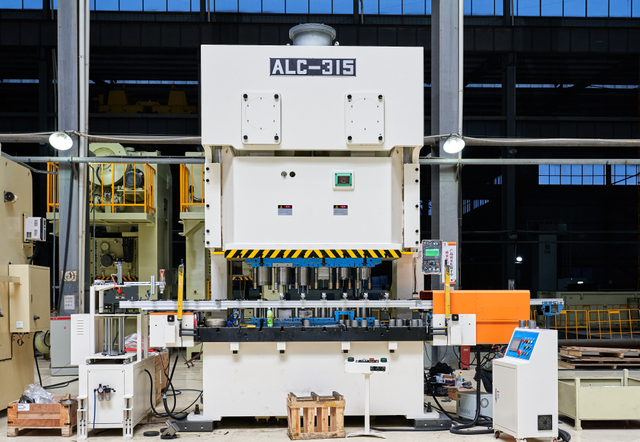
The crank design you choose is heavily influenced by the frame style of the press. The single crank configuration is the industry standard for traditional C-Frame, or gap frame, presses. The open front and sides of a C-Frame provide excellent access for manual part feeding and tooling adjustments. When paired with a single crank, it creates a versatile, high-speed machine perfect for general stamping tasks and secondary operations.
Manufacturers also produce C-Frame double crank presses. This hybrid design offers a compelling middle ground. It provides the wider bed and improved slide guidance of a double crank system while maintaining the three-sided access characteristic of a C-frame. This allows operators to run wider workpieces or small progressive dies without stepping up to a massive straight side press. However, C-frames are still subject to gaping, where the throat of the press opens up under heavy tonnage, causing angular deflection.
For heavy, wide progressive die stamping, the straight side double crank press remains the ultimate standard. Straight side frames feature four vertical columns that eliminate the angular deflection common in C-frames. These frames are often held together by massive steel tie rods pre-tensioned with hydraulic nuts. When you combine the rigid four-pillar design with the dual-point suspension of a double crank, you achieve maximum structural integrity and precision.
Matching the press bed size to your die and workpiece dimensions is a strict engineering requirement. A general guideline dictates that the tooling should cover at least two-thirds of the left-to-right bed dimension to ensure proper load distribution. If a die is too small for a large bed, the concentrated force can cause the slide to bow downward in the center.
Single crank presses are strictly restricted to small-to-medium dies. If you place a wide die in a single crank press, the ends of the tooling will overhang the central connection point. When the press cycles, the unsupported ends of the slide can deflect upward. This uneven pressure causes rapid die wear, poor part quality, and can eventually fracture the pitman arm or shatter the eccentric shaft.
Double crank presses are engineered specifically to accommodate large, multi-station progressive dies and bulky workpieces. The wide spacing of the two pitman arms supports the slide across its entire length. This structural integrity allows you to run wide coil stock through multiple forming stations without compromising the parallelism of the slide or the quality of the finished part.
Parameter | Single Crank Press Capability | Double Crank Press Capability |
|---|---|---|
Maximum Die Width | Limited to the center 50% of the bed area | Can span up to 90% of the left-to-right bed area |
Off-Center Load Tolerance | Very low; prone to severe slide tipping | High; dual pitmans resist tipping moments |
Progressive Die Suitability | Poor; only suitable for very short, compact dies | Excellent; designed for long, multi-station dies |
Slide Deflection Risk | High at the outer edges of the slide | Low across the entire span of the slide |
Slide parallelism refers to the slide's ability to remain perfectly flat and parallel to the bolster plate during the entire stamping stroke. In precision metal fabrication, maintaining strict parallelism is non-negotiable. Even a few thousandths of an inch of deflection can cause punches to shear, dies to chip, and parts to fail quality inspections. Modern presses use eight-point gibbing systems to maintain this alignment, but the gibs can only do so much if the core architecture is mismatched to the job.
Off-center loading is the primary enemy of slide parallelism. In progressive stamping, you often have operations like heavy drawing or coining occurring at one end of the die, while lighter piercing occurs at the other. This creates an asymmetrical load. The force required to form the part is not centered under the slide, creating a severe tipping moment that attempts to pry the slide out of its tracks.
The dual-point suspension of a double crank press effectively mitigates this slide tipping. When an asymmetrical load pushes up against one side of the slide, the corresponding pitman arm resists the force, while the second pitman arm keeps the opposite side stabilized. This mechanical resistance maintains tight tolerances and protects delicate tooling under the most demanding off-center conditions.
A common misconception in the metal forming industry is that a double crank press automatically provides double the tonnage of a single crank press. This is false. A 200-ton single crank press and a 200-ton double crank press both deliver a maximum of 200 tons of force. The difference lies entirely in how that tonnage is distributed across the bed.
A single crank press concentrates its full rated tonnage directly down the center line of the machine. A double crank press distributes its rated tonnage across the two connection points. Therefore, you must calculate the required tonnage per square inch of your die area. If you need highly concentrated force in a small area, a single crank is highly efficient. If you need that force spread across a 72-inch wide progressive die, the distributed tonnage of a double crank is mandatory.
When evaluating a single crank vs double crank press, you must map your tonnage curve against the physical width of your tooling. Applying high tonnage to a small, off-center area in a double crank press can actually overload one of the pitman connections, even if the total press tonnage rating is not exceeded. You must also account for reverse tonnage, or snap-through shock, which occurs when the punch breaks through the material. Double crank presses generally absorb this shock better across wide spans.
Strokes per minute (SPM) capabilities vary significantly between the two architectures. Production speed is directly tied to the mass of the moving components and the length of the stroke. Single crank presses generally feature lighter slides, a single pitman arm, and a more compact drive train. The clutch and brake mechanisms have less inertia to overcome during engagement and disengagement.
Because they have a lower moving mass, single crank presses generally achieve much higher speeds. They can accelerate and decelerate the slide rapidly, making them exceptionally well-suited for rapid, light-duty blanking operations where cycle time is the primary driver of profitability. Some single crank machines can exceed hundreds of strokes per minute in continuous operation.
Double crank presses carry significantly more mass. The wider slide, dual pitmans, and heavier gearing require more time to complete a stroke. While they operate at lower SPM, their value lies in their ability to perform complex, heavy-duty forming across multiple stations simultaneously. They produce a finished, complex part with every stroke rather than relying on secondary operations, which ultimately increases overall throughput for complex assemblies.
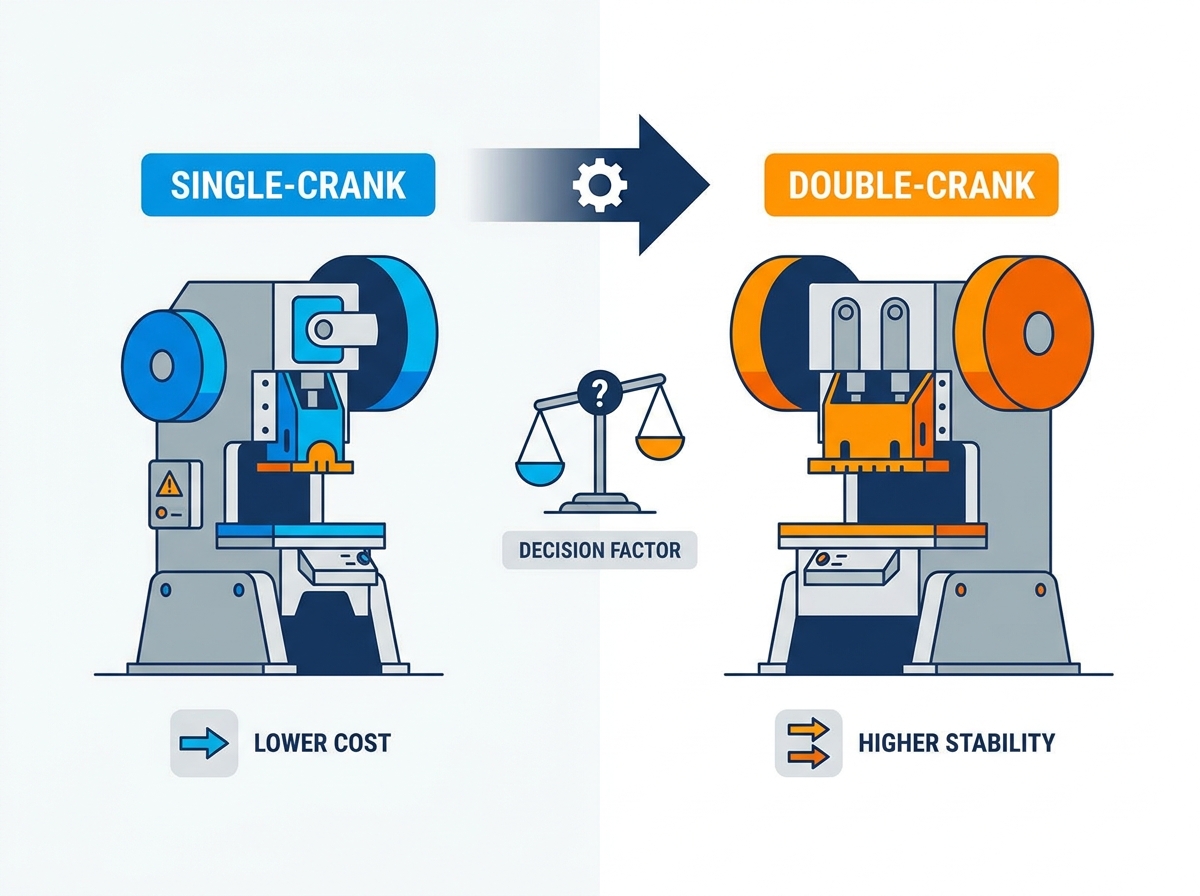
The upfront cost disparity between these two press types is substantial. Double crank presses require significantly more raw materials to construct. The frames are wider and thicker to support the dual suspension points. The drive trains involve complex machining, synchronized gearing, and heavier clutches and brakes. This engineering complexity naturally results in a higher initial capital expenditure.
Shipping and rigging costs also factor heavily into the initial CapEx. A straight side double crank press often requires specialized low-boy trailers for transport and heavy-lift gantries for installation. Single crank presses, particularly C-frame models, can often be moved with standard heavy-duty forklifts and shipped on standard flatbeds, drastically reducing the cost of deployment.
Single crank presses offer a lower barrier to entry. Their streamlined design requires less steel and simpler manufacturing processes. For facilities focused on high-volume, small-part production, the lower initial CapEx allows for faster ROI and the ability to deploy multiple machines across the floor for redundancy. However, double crank presses often depreciate slower due to their heavy-duty construction and versatility in handling complex, high-margin jobs.
There is a direct, measurable correlation between slide parallelism and die wear. Tooling is often the most expensive asset in a stamping facility. When a slide tips due to off-center loading, the punch enters the die cavity at an angle. This causes uneven wear, galling, and eventually catastrophic die crashes. Replacing shattered carbide punches can cost thousands of dollars and halt production for days.
The higher initial cost of a double crank press is frequently offset by drastically reduced tooling maintenance. By maintaining strict parallelism, the press protects the die. You will experience longer runs between sharpenings, fewer rejected parts due to burrs, and a significantly lower risk of breaking expensive components. The press frame absorbs the punishment so the tooling does not have to.
Maintenance realities differ sharply between the two designs. Single crank presses are easier and cheaper to service. Accessing the single pitman connection and eccentric shaft is straightforward. Double crank presses require highly skilled technicians to ensure the precise synchronization of the dual crankshafts. If the timing is off even slightly, the press will bind, causing severe damage to the drive train. Repairs are more labor-intensive and require specialized lifting equipment due to the weight of the components.
Physical dimensions and weight must be factored into your facility planning. A double crank press is inherently wider and taller than a single crank press of the same tonnage. This requires careful consideration of ceiling heights, overhead crane clearances, and aisle widths for material handling and die changes. You must ensure your facility can physically house the equipment before signing a purchase order.
The hidden costs of installation can be significant. Single crank presses, especially smaller C-frame models, can often be bolted directly to a standard reinforced factory floor. Their lower mass and centralized force generate manageable vibration that standard concrete can absorb without cracking.
Heavy double crank presses frequently require specialized foundation work. The dynamic loads generated by stamping wide parts across a large bed can destroy standard concrete floors. Installation may require excavating the floor, pouring isolated, reinforced concrete pits up to several feet deep, and installing engineered vibration isolation pads to protect surrounding equipment and building structures from seismic shockwaves.
A common implementation risk is falling into the trap of over-specifying equipment. Purchasing a double crank press for small, centered loads or moderate production volumes results in wasted capital. You are paying for width and stabilization that your tooling simply does not require.
Furthermore, running small dies in the center of a large double crank press can actually cause the slide to bow downward in the middle over time. This bowing effect causes the punches in the center of the die to penetrate deeper than intended, ruining part tolerances. You also take on unnecessary maintenance overhead, higher energy costs, and sacrifice valuable floor space without gaining any operational advantage.
The dangers of under-specifying are far more severe. Attempting to run wide progressive dies on a single crank press is a recipe for catastrophic failure. The extreme off-center loads will force the slide to tip with every single stroke, fighting against the gibs and the frame.
This tipping action places immense stress on the gibs, the frame, and the pitman connection. Over time, this practice leads to snapped pitman arms, cracked press crowns, and shattered tooling. The resulting downtime, lost production, and massive repair costs will far exceed the money saved by purchasing the smaller press initially.
To mitigate these risks, you must conduct a rigorous audit of your current and future tooling inventory before finalizing machine specifications. Document the left-to-right and front-to-back dimensions of every die you intend to run. Note the required tonnage, the material thickness, and the specific operations occurring within the die stations.
Advise your engineering team to map center-of-load calculations for your most demanding parts. Identify exactly where the heaviest forming takes place within the die layout. If the center of load falls outside the middle 60% of the die's left-to-right dimension, you are dealing with a severe off-center load that necessitates a double crank architecture.
Factor in your automated material handling requirements. Wide coil feeders, heavy-duty straighteners, and complex transfer systems often require the wider windows and bed spaces provided by double crank straight side presses. Ensure the press you select can physically integrate with your existing automation equipment.

Single crank presses excel in specific manufacturing environments where speed and centralized force are paramount. They are the workhorses for operations that do not require massive bed widths or complex progressive tooling.
High-speed blanking of small to medium-sized components from narrow coil stock.
Piercing and punching operations using single-station dies.
Coining and embossing small parts where high, concentrated tonnage is required in a small footprint.
Secondary operations where parts are manually fed into the center of the bed by an operator.
Short-run production jobs requiring frequent die changes and rapid setup times.
These machines are perfectly targeted for job shops handling light-to-medium duty jobs. They fit well in facilities with moderate production volumes, frequent die changes, and limited floor space. Their simplicity allows operators to quickly set up and tear down jobs, maximizing spindle time for short-run production.
Double crank presses are engineered for heavy-duty, complex forming operations that span a wide physical area. They provide the stability required for modern, multi-step manufacturing processes that demand high precision.
Running large, multi-station progressive dies that perform blanking, piercing, and forming in a single pass.
Deep drawing operations requiring consistent, parallel pressure throughout a long stroke.
Asymmetrical part forming where the load is heavily concentrated on one side of the tooling.
Heavy-duty automotive, appliance panel, and aerospace component fabrication.
Automated transfer die operations requiring wide upright spacing for part transfer mechanisms.
These presses belong in high-volume, continuous production facilities. They are designed for environments requiring maximum uptime, the handling of large workpieces, and the maintenance of tight tolerances on wide, complex components. When tool protection and part accuracy over a wide span are non-negotiable, the double crank is the only viable option.
Operational Requirement | Recommended Architecture | Engineering Justification |
|---|---|---|
High-Speed Blanking (Small Parts) | Single Crank | Lower moving mass allows for rapid acceleration and higher SPM. |
Wide Progressive Dies | Double Crank | Dual pitmans prevent slide tipping and protect complex tooling. |
Heavy Off-Center Loading | Double Crank | Two-point suspension absorbs asymmetrical forces without deflection. |
Concentrated Coining | Single Crank | Direct central force application maximizes energy transfer to a small area. |
Deep Drawing Large Panels | Double Crank | Maintains strict parallelism throughout the entire length of the draw stroke. |
When finalizing your decision on a single crank vs double crank press, always default to the physical dimensions of your largest, most complex die. Tonnage is only one part of the equation; force distribution dictates the survival of your tooling and the quality of your parts.
Audit your existing die inventory to determine the maximum left-to-right dimensions and off-center load severity for your heaviest jobs.
Calculate the required tonnage per square inch for your most demanding progressive stamping operations to ensure proper force distribution.
Consult with a structural press engineer to map your center-of-load data against specific machine frame architectures.
Request technical specifications and layout drawings to verify facility footprint, overhead clearance, and concrete foundation requirements.
A: The main difference is the number of connection points between the crankshaft and the slide. A single crank has one central connection, concentrating force in the middle. A double crank has two connections, distributing force across a wider left-to-right bed area.
A: You should upgrade when transitioning to wider progressive dies, handling larger workpieces, experiencing premature tool wear due to slide tipping, or taking on jobs that generate severe off-center loads during the stamping process.
A: Not necessarily. Both architectures can be built to achieve high tonnages. The difference is that a double crank press distributes its rated tonnage over a wider left-to-right area, whereas a single crank concentrates it centrally.
A: A double crank's two-point suspension actively resists the tipping forces that occur when stamping off-center. This maintains strict parallelism between the slide and the bed, unlike a single center connection which is prone to tilting under uneven loads.
A: Yes, C-Frame double crank presses exist. They offer a wider bed and improved slide guidance to handle larger parts, while still maintaining the open front and side access typical of traditional C-frame architectures.
A: Yes. They feature more moving parts, require precise synchronization of the dual pitmans or dual crankshafts, and generally involve heavier components. This increases both routine service time and the complexity of major repairs.