
Views: 0 Author: Site Editor Publish Time: 2026-08-10 Origin: Site


Misaligning capital equipment with actual production needs results in severe bottlenecks, inflated tooling costs, and compromised floor safety. Facility managers and procurement teams frequently encounter overlapping terminology when evaluating metalworking machinery. While operators often use the terms interchangeably on the shop floor, the engineering realities, tooling architectures, and regulatory compliance burdens of these machines are vastly different. Clarifying the technical distinctions between a general power press and a dedicated punch press is necessary for optimizing high-volume stamping versus high-mix fabrication. This guide breaks down the mechanical differences, operational trade-offs, and compliance frameworks required to make an evidence-based procurement decision when evaluating a power press vs punch press. We will look at force generation, tooling complexity, and material handling to ensure your next machinery acquisition aligns perfectly with your production floor requirements.
Table of Contents
Categorical Distinction: A punch press is technically a specialized subset of a power press. However, in industrial procurement, "power press" denotes heavy-duty stamping and forming equipment, while "punch press" refers to machines dedicated to high-speed hole making and material removal.
Tooling and Changeovers: Power presses rely on large, expensive, custom-built dies ideal for long production runs. Punch presses utilize standardized, interchangeable punch-and-die sets suited for rapid changeovers and high-mix production.
Regulatory Scrutiny: Mechanical power presses fall under strict OSHA 29 CFR 1910.217 regulations, requiring rigorous safeguarding, clutch/brake inspections, and compliance documentation that do not apply equally to hydraulic presses or press brakes.
Throughput vs. Flexibility: Power presses dominate in sheer throughput for uniform parts; punch presses offer superior geometric flexibility for complex, multi-feature sheet metal components.
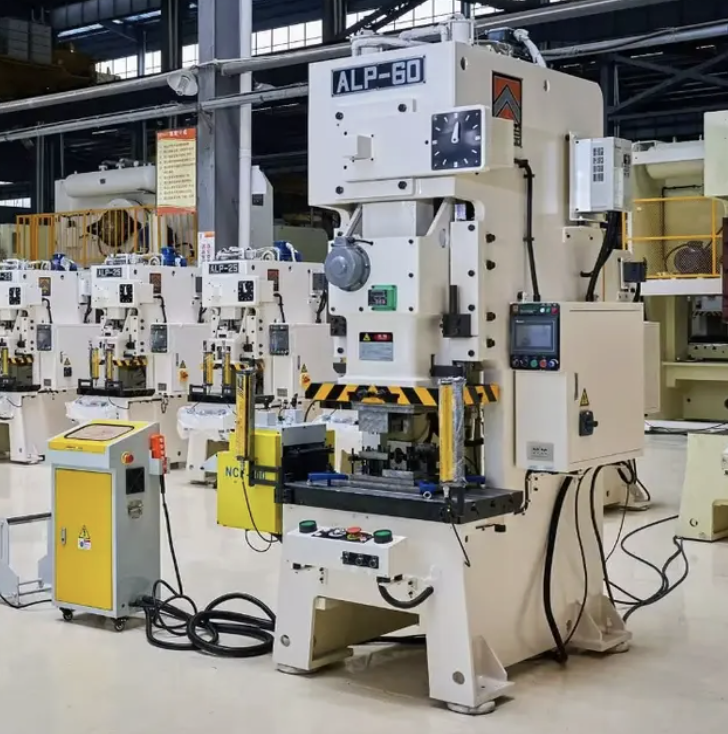
A power press represents a broad category of machine tools designed to shear, punch, form, or assemble metal. These machines utilize tools or dies attached to a reciprocating slide, commonly known as a ram, which descends onto a stationary bed. The fundamental purpose of a power press is to alter the shape or internal structure of a workpiece through immense, concentrated pressure. Frame styles vary heavily, with C-frame (or gap-frame) presses offering three-sided access for manual part loading, while straight-side presses provide superior rigidity for high-tonnage, off-center loading applications.
The primary drive mechanisms dictating power press operation include:
Mechanical Drives: These systems convert circular or rotary motion from a massive, continuously spinning flywheel into linear motion via a crankshaft, eccentric gear, or toggle mechanism. They deliver rapid, high-impact force specifically at the bottom of the stroke.
Hydraulic Drives: Utilizing fluid pressure acting upon a piston, hydraulic presses deliver consistent, controllable tonnage throughout the entire stroke length. You will typically see these deployed for deep drawing operations where material needs time to flow without tearing.
Pneumatic Drives: Powered by compressed air, pneumatic presses are reserved for lighter-duty assembly, staking, or shallow forming tasks requiring fast actuation but lower overall tonnage.
In the industrial manufacturing sector, the primary use case for a power press involves high-tonnage stamping, deep drawing, and heavy forming. These machines process coil-fed or blank-fed sheet metal, stamping out identical parts continuously. They form the backbone of industries requiring massive output of uniform components, operating at capacities ranging from 50 tons to well over 3,000 tons.
A punch press is a highly specialized machine engineered primarily for material removal. Rather than forming deep contours or stamping entire panels in a single stroke, a punch press focuses on cutting holes, louvers, notches, and complex geometric shapes into flat sheet metal. It achieves this by driving a hardened steel punch through the workpiece and into a matching die, shearing a specific shape and ejecting the scrap slug through the bottom of the die matrix.
Modern punch presses are defined by their configurations and advanced power sources:
CNC Turret Punch Presses: These machines house multiple tools simultaneously within a rotating turret. The machine rapidly indexes the required tool over the striking mechanism, allowing for continuous processing of complex parts without manual tool changes. Auto-index stations within the turret can rotate the punch and die 360 degrees to cut angles without requiring custom-shaped tools.
Single-Station Punch Presses: Often used for simpler, repetitive tasks or heavy plate punching, these machines hold one punch-and-die set at a time. Operators must manually swap the tooling for different hole sizes.
Drive Systems: While older models rely on mechanical flywheels, modern punch presses frequently utilize hydraulic rams or advanced servo-electric systems. Servo-electric drives offer extreme precision, programmable stroke depths, and lower energy consumption, often achieving hit rates exceeding 1,000 hits per minute on tight centers.
The primary industrial use case for a punch press is high-mix, low-to-medium volume sheet metal fabrication. Facilities producing electrical enclosures, custom brackets, or aerospace panels rely on punch presses for rapid, precise, and varied hole-punching operations where part geometries change frequently and sheet sizes often reach 4x8 or 5x10 feet.
Procurement teams frequently experience confusion when evaluating metalworking machinery, often overlapping requirements with press brakes. When comparing a power press vs punch press, you must establish clear boundaries regarding machine capabilities to avoid misallocating capital.
Power presses and punch presses are designed fundamentally for material removal, piercing, blanking, and deep forming. They utilize enclosed dies or punch-and-die sets to shear or draw metal. A press brake, by contrast, is strictly a linear geometric shaper. It is used exclusively for bending and folding sheet metal along a straight axis. Press brakes utilize long, V-shaped dies and matching punches to fold metal into angles, channels, and complex profiles. They do not punch holes, shear blanks, or perform deep drawing. Understanding this distinction prevents costly errors when outfitting a fabrication shop.

The mechanics of force generation dictate how each machine interacts with the raw material. Mechanical power presses rely on massive kinetic energy transfer. A heavy flywheel stores rotational energy, which is suddenly engaged via a clutch. This results in high-impact, full-tonnage delivery specifically at the bottom of the stroke, known as bottom dead center (BDC). The force curve is sharp and aggressive, designed to snap through thick material or coin heavy features in a fraction of a second.
The sequence of mechanical force generation follows a strict mechanical path:
The main motor spins the heavy flywheel continuously to build kinetic energy.
The operator or automation system initiates the cycle via dual palm buttons or a foot pedal.
The clutch engages, locking the spinning flywheel to the stationary crankshaft.
The rotary motion of the crankshaft converts to linear motion via the pitman arm.
The ram descends, delivering maximum tonnage exactly at bottom dead center before returning to the top of the stroke and engaging the brake.
Punch press mechanics prioritize high-cycle, rapid-fire actuation. Rather than delivering massive, full-bed forming tonnage, a punch press delivers localized shearing force. The ram actuates hundreds of times per minute, nibbling away material or punching discrete holes. Modern servo-electric punch presses offer programmable stroke profiles. This allows operators to control the ram's acceleration, deceleration, and dwell time, enabling specialized forming operations like tapping threads, rolling wheel ribs, or creating precise countersinks without warping the surrounding sheet metal.
Tooling represents the most significant operational divergence between these machines. Power press tooling relies heavily on progressive dies, transfer dies, or large single-hit forming dies. A progressive die is a complex, multi-station tool custom-engineered for a specific part. As the metal coil feeds through the press, each station performs a distinct operation—piercing, notching, bending, and finally blanking the finished part. These dies involve high initial engineering costs and long manufacturing lead times. They require internal pilot pins to align the material strip, lifters to advance the material over the die blocks, and a carrier web to hold the part until the final cutoff station. Once installed, they yield an exceptionally low cost-per-part at scale, producing thousands of parts per hour unattended.
Punch press tooling utilizes standard, modular punch-and-die sets. Configurations like thick turret, thin turret, or Trumpf-style tooling allow fabricators to keep a vast library of standard shapes on hand. This tooling architecture boasts a significantly lower initial cost. Because the tools are standardized and modular, a CNC turret punch press can be easily programmed to execute complex nesting layouts. Die clearance is critical here. Operators must manually select the correct die size based on material thickness—typically 15% to 20% of the material thickness for mild steel. Incorrect clearance leads to excessive burrs, accelerated tool wear, and poor edge quality. The machine combines standard hits to cut out entirely custom exterior profiles without requiring a dedicated blanking die.
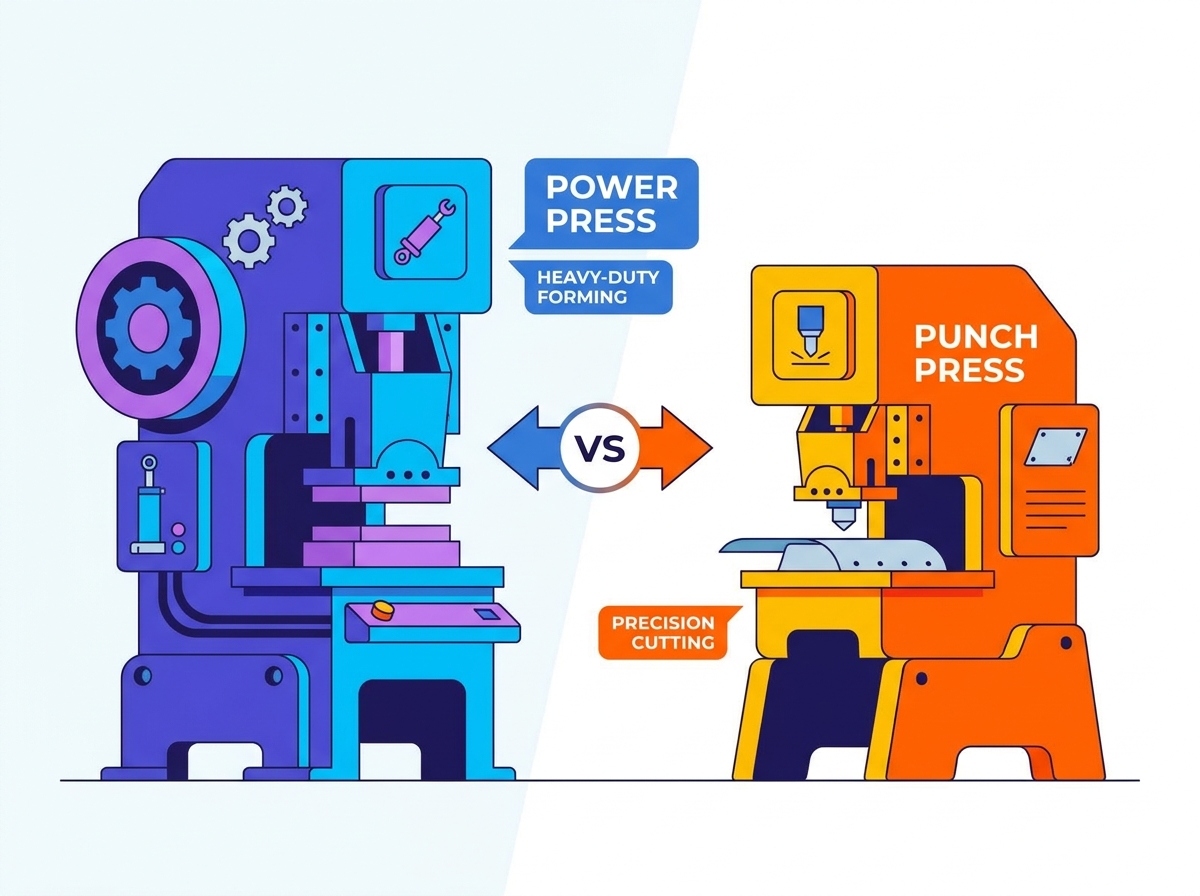
Deploying a mechanical or hydraulic power press is justified when production volumes demand relentless repetition. These machines are ideal for production runs exceeding 50,000 identical units. The upfront investment in custom tooling is rapidly amortized across the sheer volume of parts produced. You will see these machines processing advanced high-strength steels, aluminum alloys, and heavy-gauge structural materials.
Power presses are best suited for parts requiring simultaneous blanking, piercing, and deep drawing. Because a progressive die performs all these actions in a single, synchronized sequence, the cycle time per part is measured in fractions of a second. Typical examples of power press applications include automotive body panels, structural chassis components, appliance housings, heavy-duty brackets, and electrical motor laminations. If the part design is locked and the volume is massive, the power press is the undisputed optimal choice.
A CNC punch press excels in environments where flexibility dictates profitability. It is ideal for just-in-time manufacturing, rapid prototyping, and variable batch sizes. Contract manufacturers who process dozens of different part designs in a single shift rely on the punch press to pivot quickly without tooling bottlenecks. The software nests multiple different parts onto a single sheet of metal, utilizing micro-joints to hold the parts in the skeleton until the sheet is unloaded.
This equipment is best suited for flat sheet metal parts requiring dense, varied hole patterns, extensive nibbling to create large cutouts, or minor forming operations like countersinks, louvers, and embossments. Common examples include electrical control enclosures, HVAC ductwork components, precision aerospace panels, and custom architectural metalwork. The ability to load a new CNC program and instantly begin producing a completely different part makes the punch press indispensable for high-mix fabrication.

Evaluating base machine costs reveals distinct financial trajectories. Heavy-tonnage power presses require substantial infrastructure investments. Installing a 500-ton mechanical press often necessitates significant foundation work, including deep pit construction, soil core sampling, and specialized vibration isolation pads to prevent seismic shockwaves from damaging the facility floor. This infrastructure adds heavily to the initial CapEx and makes relocating the machine extremely difficult.
Lifecycle maintenance also diverges sharply. Hydraulic power presses demand rigorous fluid management, regular oil analysis, and inevitable cylinder seal replacements to maintain pressure integrity. Mechanical power presses require constant monitoring of clutch and brake wear, as well as lubrication of massive gear trains. Punch presses generally incur lower heavy-mechanical maintenance, as their tonnage is much lower. However, they require strict upkeep of CNC controls, servo motors, and ball screws. Dust and metal particulates must be meticulously managed to prevent premature wear on the precision linear guides that position the sheet metal.
The financial viability of a power press hinges on calculating the return on investment threshold for progressive dies. If a die requires extensive engineering to design and build, the production run must be large enough that the tooling cost per part drops to pennies. Furthermore, facilities must assess the labor costs associated with die changes. Implementing Single-Minute Exchange of Die (SMED) principles is mandatory. Swapping a massive progressive die requires overhead cranes, heavy forklifts, die carts, and hydraulic clamping systems. Poorly managed changeovers can result in hours of machine downtime.
Conversely, a CNC turret punch press eliminates heavy die handling. Tooling amortization is negligible because standard punches are reusable across hundreds of different part designs. Changeover realities are measured in milliseconds. Automated, sub-second tool indexing allows the machine to switch from punching a quarter-inch round hole to a two-inch square hole instantly. The primary tooling cost involves routine maintenance—using a surface grinder to sharpen punches and dies to prevent galling and burr formation on the sheet metal.
To maximize throughput, material handling systems must match the machine's cycle times. Power press integration typically involves continuous coil processing. A standard stamping line includes a heavy motorized uncoiler to hold the master coil, a straightener to remove the natural curvature of the steel, and a servo-driven roll feeder to advance the material precisely. A slack loop sits between the straightener and the feeder, monitored by ultrasonic sensors to ensure the feeder always has enough slack material to pull from without jerking the heavy master coil. This setup enables continuous, unattended stamping.
Punch press integration focuses on discrete sheet metal processing. These machines are usually paired with automated sheet loaders that use vacuum cups to pick raw sheets from a material tower. Brush tables prevent the sheet metal from scratching as it moves across the machine bed. After processing, automated part-picking systems or drop chutes sort finished components, while unloaders remove the remaining web of scrap metal. This automation supports lights-out manufacturing for high-mix fabrication, allowing the machine to switch between different sheet thicknesses and part programs automatically.
Feature | Power Press (Stamping) | Punch Press (Fabrication) |
|---|---|---|
Primary Function | Deep forming, blanking, high-tonnage stamping | Hole punching, nibbling, localized shearing |
Tooling Type | Custom progressive or transfer dies | Standardized, modular punch-and-die sets |
Production Focus | High volume, low mix (uniform parts) | High mix, low-to-medium volume (variable parts) |
Material Feed | Continuous coil feeding | Discrete sheet loading/unloading |
Changeover Speed | Slower (requires heavy die setting) | Rapid (automated turret indexing) |
The human element required to run these machines dictates hiring and training strategies. Power press operation requires deep expertise in heavy die setting, coil feeding alignment, and mechanical troubleshooting. Operators must understand tonnage curves, shut height adjustments, and the physical behavior of metal as it stretches and draws. They must know how to adjust the counterbalance cylinders to offset the weight of the upper die half. Rigorous safety protocol training is paramount due to the sheer kinetic energy involved.
Punch press operation shifts the required skill set toward digital and precision competencies. Operators require CNC programming proficiency and an understanding of CAD/CAM integration. They must know how to optimize nesting software to maximize material yield and prevent sheet distortion during dense punching sequences. While physical danger is lower due to enclosed guarding, operators must master standard tool maintenance, managing punch clearance tolerances based on material thickness and tensile strength.
Regulatory compliance is a major differentiator when evaluating a power press vs punch press. The regulatory framework governing mechanical power presses is exceptionally strict. OSHA 29 CFR 1910.217 dictates specific, mandatory safety protocols for mechanical presses due to their high historical incident rates of amputation. This standard differentiates heavily between part-revolution clutches, which can be stopped mid-stroke, and full-revolution clutches, which cannot be stopped once engaged until the cycle completes.
You must clarify the regulatory boundary on your shop floor. Hydraulic power presses, pneumatic presses, and press brakes do not fall under the strict 1910.217 standard. Instead, they are regulated under the general machine guarding standard, OSHA 1910.212. For mechanical power presses under 1910.217, facilities must implement mandatory requirements including presence-sensing device initiation, redundant two-hand controls, control reliability circuits, brake monitors, and robust physical barrier guards. Failure to maintain detailed inspection logs of clutches and brakes results in severe compliance penalties.
While punch presses are generally safer regarding amputation risks compared to open-die stamping presses, they present unique safeguarding challenges. CNC turret presses and single-station machines require specific guarding to protect operators from the rapidly moving sheet metal and the automated positioning clamps.
Implementation risks center around automated sheet handling. The X and Y axes move the sheet metal at high velocities, creating severe pinch points and blunt force hazards. Risk mitigation requires perimeter fencing around the entire machine envelope, interlocked access gates that halt machine motion when opened, and light curtains protecting the loading and unloading zones. Facilities must ensure that operators cannot reach over, under, or through the guarding while the automated sheet loaders and skeleton destructors are in motion.
The decision ultimately rests on a matrix of production volume and part complexity. If the manufacturing strategy relies on producing identical, highly contoured, or deep-drawn parts in massive quantities, the mechanical or hydraulic power press is the only viable solution. The initial capital and tooling costs are offset by unmatched production speed and low per-part costs.
If the facility operates as a job shop, contract manufacturer, or produces complex, flat-pattern parts with high variability and short lead times, the CNC punch press is the required asset. Its ability to utilize standard tooling to create infinite geometric variations without die changeovers provides the agility necessary to remain competitive in a high-mix environment. Analyzing historical part data, projected batch sizes, and frequency of design revisions will clearly indicate which machine aligns with the facility's operational goals.
Audit your historical production data to determine your true mix-to-volume ratio before committing to capital equipment.
Evaluate your facility's infrastructure capacity, specifically regarding foundation requirements and floor loading, prior to purchasing heavy-tonnage stamping equipment.
Assess your internal maintenance capabilities, ensuring your team can support either complex hydraulic systems or precision CNC servo drives.
Review your current safety compliance programs to ensure readiness for OSHA 1910.217 requirements if acquiring a mechanical press.
Founded in 1983, Zhejiang Jinaolan Machine Tool specializes in 25- to 2,400-ton mechanical presses and integrated stamping solutions, including feeding systems, stamping dies, transfer equipment, and automated production lines. Its engineering and manufacturing experience can help buyers match press capacity, tooling, and automation to their specific production requirements.
A: Yes, modern CNC punch presses can perform light forming operations. Using specialized tooling and programmable stroke control, they can create louvers, countersinks, embossments, and extruded tapped holes. However, they cannot perform the deep drawing or heavy forming achieved by a dedicated power press.
A: Mechanical power presses use flywheels and clutches that transfer massive kinetic energy instantly. Older full-revolution models cannot be stopped mid-stroke, presenting a severe amputation hazard. Hydraulic presses move slower and can be stopped instantly by cutting fluid pressure, placing them under general machine guarding standards rather than strict mechanical press regulations.
A: Servo-electric punch presses offer precise control over the ram's speed and position throughout the stroke. This allows for quieter operation, lower energy consumption, and the ability to perform delicate forming operations without distorting the sheet metal, compared to traditional hydraulic or mechanical punch presses.
A: No. CNC punch presses use standard, modular punch-and-die sets stored in a turret. The machine's software nests the hits to cut out complex shapes. Progressive dies are custom-built, multi-station tools used exclusively in power presses for high-volume stamping.
A: Power presses typically utilize continuous coil feeding systems, where a roll of steel is continuously fed through the die. Punch presses process discrete, flat sheets of metal, requiring automated vacuum loaders or manual sheet placement to feed the material into the machine's clamps.
A: No. A press brake is designed to bend and fold sheet metal along a linear axis. It does not remove material. A punch press is designed to shear, pierce, and cut holes out of flat sheet metal. They perform entirely different functions in the fabrication process.