
Views: 0 Author: Site Editor Publish Time: 2026-01-28 Origin: Site


Have you ever wondered how metal parts are shaped so fast and accurately in factories? The answer is often a Power Press. A Power Press replaced slow manual metal forming by delivering high force, speed, and precision for modern manufacturing needs. In this article, you’ll learn what a Power Press is, how it works, and where it’s used.
A Power Press is an industrial machine designed to shape, cut, or form materials using controlled mechanical force. In simple terms, it helps factories turn flat sheets into precise parts quickly and repeatedly. Technically, a power press converts electrical, pneumatic, or hydraulic energy into linear motion, driving a ram to press dies together. It plays a central role in modern manufacturing because it delivers speed, accuracy, and consistency at scale.
In real production environments, many problems appear when metal forming relies only on manual tools. They work slowly, demand heavy labor, and often produce uneven results. A Power Press solves these issues by applying stable force every cycle, reducing human effort and minimizing errors. It also improves safety and output quality, which matters when thousands of identical parts are required.
Compared to hand-operated presses, power presses represent a major upgrade. Manual presses rely on human strength, limiting pressure and production speed. Power presses rely on motors or fluid systems, allowing them to handle thicker materials and complex shapes. They also support automation, making them suitable for continuous production lines instead of one-piece operations.
Power presses are considered multipurpose machines because one system can perform many operations. By changing dies and settings, the same Power Press can cut, bend, punch, or form different materials. This flexibility reduces equipment costs and saves floor space in workshops. It also allows manufacturers to adapt quickly to new product designs without replacing machines.
A Power Press supports a wide range of metalworking tasks across industries. Instead of doing one job only, it handles multiple forming and cutting operations efficiently. The table below shows common uses and what they achieve in production.
Operation Type | What the Power Press Does | Typical Results |
Cutting | Separates material along a defined edge | Clean edges, accurate sizes |
Punching | Creates holes or slots | Consistent hole shapes |
Blanking | Cuts flat shapes from sheets | Uniform parts |
Bending | Forms angles or curves | Controlled bends |
Forming | Shapes metal into contours | Complex geometries |
Shallow Drawing | Pulls metal into light 3D shapes | Smooth surfaces |
Press-Fitting | Joins parts using force | Secure assemblies |
Cutting and punching are among the most common uses. They help manufacturers produce brackets, panels, and frames at high speed. The Power Press applies force evenly, so parts remain consistent across large batches. It also reduces material waste by keeping cuts precise.
Bending, forming, and shallow drawing allow the Power Press to create three-dimensional parts. These operations shape metal without removing material, which improves strength and efficiency. They are widely used in automotive panels, appliance housings, and hardware components.
Press-fitting and assembly tasks show another side of the Power Press. Instead of shaping metal, it joins parts together using controlled pressure. They help insert bearings, rivets, or pins accurately, ensuring tight fits and reliable performance in assembled products.

A Power Press works by turning stored energy into controlled force used to shape materials. It starts when a motor creates motion, then the machine guides this motion into a straight pressing action. We use this process to cut, bend, or form metal accurately. The system repeats the same movement every cycle, helping factories maintain speed and consistency.
At the core of the Power Press working principle lies motion conversion. Rotary motion comes from a motor or fluid system, while linear motion performs the actual pressing. This conversion allows the ram to move up and down smoothly. They rely on this predictable movement to protect dies and ensure stable product quality during long production runs.
Pressure, stroke, and speed control how the Power Press behaves during forming. Pressure determines how much force presses the material. Stroke defines how far the ram travels each cycle. Speed affects productivity and surface finish, so operators balance all three depending on the task. Together, they decide whether the result looks clean, precise, or damaged.
The working cycle of a Power Press follows a fixed sequence designed for efficiency and safety. Each step plays a role in delivering force exactly when needed. The table below shows how energy flows through the system during one cycle.
Step | Process Stage | What Happens |
1 | Motor Activation | The electric motor starts rotating |
2 | Energy Storage | The flywheel stores kinetic energy |
3 | Power Transfer | The clutch connects flywheel and drive |
4 | Motion Conversion | Crankshaft or cylinder changes motion |
5 | Ram Movement | The ram moves downward |
6 | Die Contact | Upper and lower dies press material |
7 | Material Forming | Cutting or shaping occurs |
8 | Return Stroke | Ram lifts and cycle repeats |
During idle rotation, the flywheel stores energy instead of wasting it. When the clutch engages, they release this energy quickly. The crankshaft or cylinder then guides it into vertical motion. This design keeps speed stable and reduces stress on machine components.
Different Power Press types generate force in different ways. Mechanical presses rely on flywheels and crankshafts, making them fast and efficient for high-volume work. Pneumatic presses use compressed air, offering smoother control and quicker response. Hydraulic presses depend on fluid pressure, delivering full force through the entire stroke.
Stroke control and pressure consistency also vary across systems. Mechanical presses reach peak force near the bottom of the stroke. Pneumatic presses allow adjustable speed but lower force. Hydraulic presses maintain constant pressure, helping when accuracy matters more than speed. We choose based on material thickness and operation type.
Energy efficiency and operational control influence long-term costs. Mechanical systems consume less energy per stroke. Pneumatic systems require clean, dry air. Hydraulic presses need pumps and fluid maintenance. Each Power Press type balances power, control, and efficiency differently, depending on production goals.
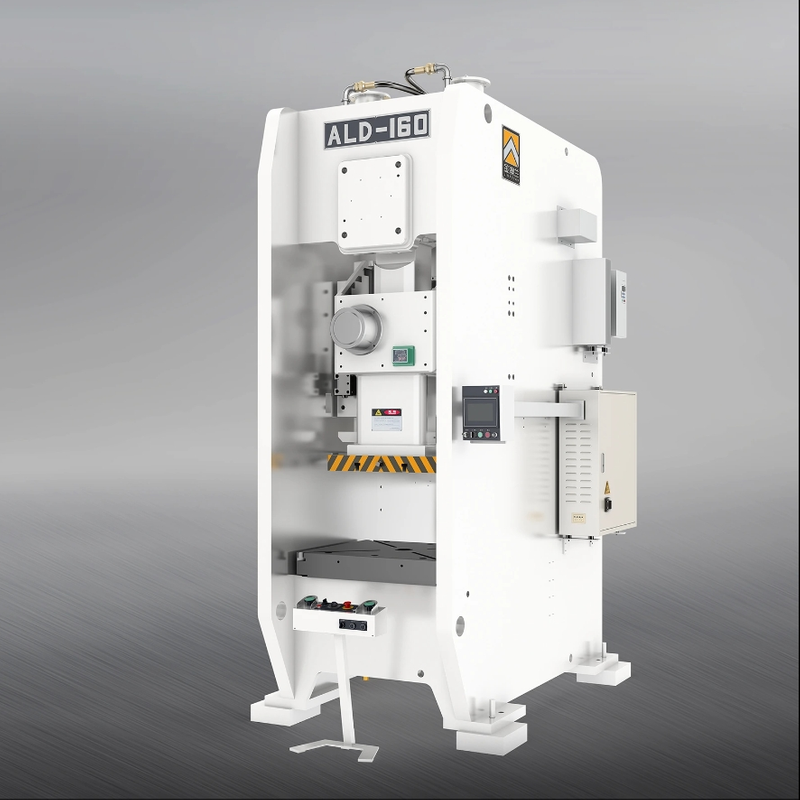
A Power Press machine is built from several coordinated systems working together. We can group them into structural, mechanical, and control components. Each group plays a different role, yet they depend on each other to deliver stable force and repeatable results. When one part performs poorly, they all feel the impact during production.
From the outside, a Power Press looks rigid and simple. Inside, it combines motion, energy storage, and control logic. They work together to guide force safely from the motor to the material. Understanding these components helps operators run machines efficiently and avoid unnecessary downtime.
Structural components form the backbone of a Power Press. The base and frame support all loads generated during pressing operations. They absorb vibration and keep the machine aligned during high-force cycles. A strong structure improves accuracy and extends tool life.
C-frame, also called gap frame, designs allow open access from three sides. They work well for light to medium-duty operations and frequent tool changes. H-frame, or straight-side designs, provide higher rigidity and better load distribution. They suit heavy-duty work where deflection must stay minimal.
Frame Type | Key Feature | Typical Use |
C-Frame | Open access, compact | Light stamping, bending |
H-Frame | High rigidity, closed | Heavy-duty forming |
Rigidity matters because uneven loads cause misalignment. When the frame bends, dies wear faster and part quality drops. They rely on proper load distribution to maintain precision during long production runs.
Mechanical components create and transfer motion inside the Power Press. The ram, also called the slide, moves vertically to apply force. It holds the upper die and delivers pressure directly to the workpiece. Operators adjust its stroke length depending on the operation.
The flywheel stores kinetic energy during idle rotation. When the clutch engages, it releases this energy quickly. The crankshaft and connecting rod convert rotary motion into linear movement. This design keeps speed steady and reduces shock during pressing.
Component | Function | Contribution |
Ram / Slide | Applies force | Shapes material |
Flywheel | Stores energy | Stabilizes speed |
Crankshaft | Converts motion | Drives ram |
Clutch | Transfers power | Starts operation |
Brake | Stops motion | Improves safety |
The clutch and brake work as a pair. The clutch connects power when pressing starts. The brake stops motion instantly when needed. Together, they protect operators and tooling during emergencies.
Electrical and control systems manage how a Power Press operates. The motor supplies power and drives the flywheel or pump. Power transmission components guide energy smoothly through the system. Without stable electrical input, performance becomes unpredictable.
Control panels allow operators to adjust speed, stroke, and mode. PLC controllers manage logic and coordinate movements. Sensors monitor position, overload, and safety conditions. They react instantly when something goes wrong.
Automation integration expands machine capability. Feeding systems, straighteners, and conveyors connect directly to the Power Press. They enable continuous production without manual handling. This integration improves efficiency, reduces errors, and supports modern manufacturing lines.
Power Press machines support many industries because they deliver speed, accuracy, and repeatable force. We see them everywhere people shape, cut, or assemble metal parts. They adapt easily to different materials and production volumes. This flexibility makes the Power Press a core machine in both heavy and light manufacturing.
Across industries, they handle everything from simple brackets to complex precision components. By changing dies and settings, one Power Press can serve multiple production lines. They reduce manual labor and help companies meet tight quality standards. The following sections show how different industries rely on this machine.
In automotive production, a Power Press helps shape large volumes of metal parts every day. It forms body panels, door components, and structural brackets quickly and consistently. These parts must fit perfectly, so accuracy matters at every stroke.
They also support high-speed stamping lines. One press can produce thousands of identical components per shift. This efficiency helps car makers control costs while meeting strict safety requirements. Power Press machines keep production moving without sacrificing precision.
Automotive Parts | Purpose | Benefit |
Body panels | Exterior structure | Smooth finish |
Door components | Assembly support | Precise fit |
Brackets | Structural strength | High durability |
The electrical and electronics industry demands small, precise components. A Power Press produces connector pins, terminals, and stamped contacts accurately. These parts must meet tight tolerances, so consistent force becomes essential.
They also shape electrical enclosures and panels. Clean edges and accurate holes help protect sensitive equipment. Power Press machines allow manufacturers to maintain quality while increasing output for growing markets.
Home appliances rely on Power Press machines for visible and hidden parts. They shape appliance panels, kitchen hardware, and internal brackets. Surface quality matters because customers see these components daily.
Furniture and household products also benefit from press operations. They form metal frames, hinges, and supports efficiently. A Power Press keeps production steady while supporting modern design trends and lightweight structures.
In construction hardware, strength and reliability come first. A Power Press produces hinges, lock bodies, and fasteners used in buildings and infrastructure. These parts must withstand repeated use and heavy loads.
They also support mass production for standard hardware. Consistent pressing ensures every piece matches specifications. Builders and suppliers depend on this reliability to maintain safety standards.
Hardware Product | Application | Key Requirement |
Hinges | Doors, cabinets | Durability |
Lock bodies | Security systems | Precision |
Fasteners | Structural joints | Strength |
Aerospace and defense industries demand extreme accuracy. Power Press machines form high-precision stamped parts for aircraft and equipment. Weight reduction matters, so they often shape lightweight structural components.
They also support specialized engineering tasks. Precision presses help maintain tight tolerances and repeatable quality. In these industries, even small errors matter, so controlled pressing becomes essential.
This article explains what a Power Press is, how it works, and where it is used. It shows how controlled force, speed, and precision support modern manufacturing across many industries. Choosing the right Power Press improves efficiency and product quality. Proper safety practices and regular maintenance help machines run reliably over long production cycles. For manufacturers and buyers, KingLan provides Power Press solutions focused on durability, precision, and service support. Their products help teams reduce downtime and create consistent value.
A: A Power Press is a machine that shapes, cuts, or forms materials using controlled mechanical force.
A: A Power Press converts rotary motion into linear motion to press dies and form materials.
A: A Power Press improves speed, accuracy, and consistency while reducing labor and errors.
A: Power Press machines handle cutting, punching, bending, forming, and light drawing tasks.
A: Power Press prices vary by tonnage, type, automation level, and safety features.
A: Power Press issues often involve misalignment, worn dies, or poor maintenance.